Location(s): Rio de Janeiro, Brazil
Dates travelled: 19th – 25th October
Day One
If you want a guide to just how big Brazil is, it took me longer to fly from Fortaleza to Rio than from London to Lisbon.
Whereas Fortaleza is hot, humid and sunny year-round, Rio, in the south, receives more varied weather. I was greeted immediately by grey, spitting clouds. Bruno Mars (lovingly called ‘Bruninho’ in Brazil) was performing the day I arrived, so the roads were chock-a.
I gave warning about this in the Fortaleza blog: Use prepaid taxis. Don’t go on the metre. Brazil’s traffic is too unpredictable for that.
Night was falling when I got to my apartment: Copa Chic in Copacabana. Given the city’s notorious crime rate, I deemed it unwise to be wandering unfamiliar streets after dark.
Rappi and iFood are good apps for ordering takeaway in Brazil. I ordered a steak and noodle box (regrettable choice), and watched some Netflix whilst planning the week ahead. Before you book accommodation in Brazil, ensure it has air-con. My apartment had strong fans which did the trick, but say I went to the same place in the summer, I would likely have struggled. Let’s get into a week in Rio.
Day Two
Still unable to pay on card, my gym choices were limited. I bought a costly day pass at Bodytech around the corner from Copa Chic and started with legs again. My gaff had a fridge so I was sure to acquire yoghurt and berries on the way home. The weather was too glum for a day on the beach, so despite the heavy leg session, I chose to ‘bater as pernas’ (literally “beat the legs” or take a walk) through the city.
I Ubered to Flamengo, a borough close to Lapa, and padded north through the warm but very rainy day. When one thinks of Rio, they probably think of a sun-drenched city loaded with Samba parties and beaches packed full of the most tanned and gorgeous humans ever to grace the earth. Some days you do get that. But not when it’s raining. Rio is something of a beach city, or at the very least a fair-weather city. When it’s wet and miserable, people stay indoors. I never thought I’d say it, but I felt lonely trekking around on my first day.
I stayed near the water, breezing through various parks and sighting monuments along Praia do Flamengo with Lapa in my crosshairs. Taken aback though I was by Rio’s emptiness, I quite enjoyed having the streets to myself, and the peaceful marinas with only moored boats for company.
Os Arcos da Lapa, formerly known as the Aqueduto da Carioca, were originally constructed to provide clean water to those living in central Rio. Impressive structure, and whilst I’m certain it’s more appeasing under a blue sky, its importance is retained in any weather.
Near to it is the Catedral Metropolitana de São Sebastião. Now, I’ve laid eyes on a fair few metropolitan cathedrals in my time, but I’m hard-pressed to recall one on the scale of Rio’s. The awe-inspiring pyramid, despite being built half a century ago, appears futuristic even today. That’s just from outside. Indoors, it gets sexier. Three brightly-coloured towers of stained glass breathe life into the interior, combining with the soothing piano tune to transport you to a place of pure quietude. I took a seat and let my eyes absorb the central alter, the hanging sculpture of Christ on the cross, the old pipe organ and so on.
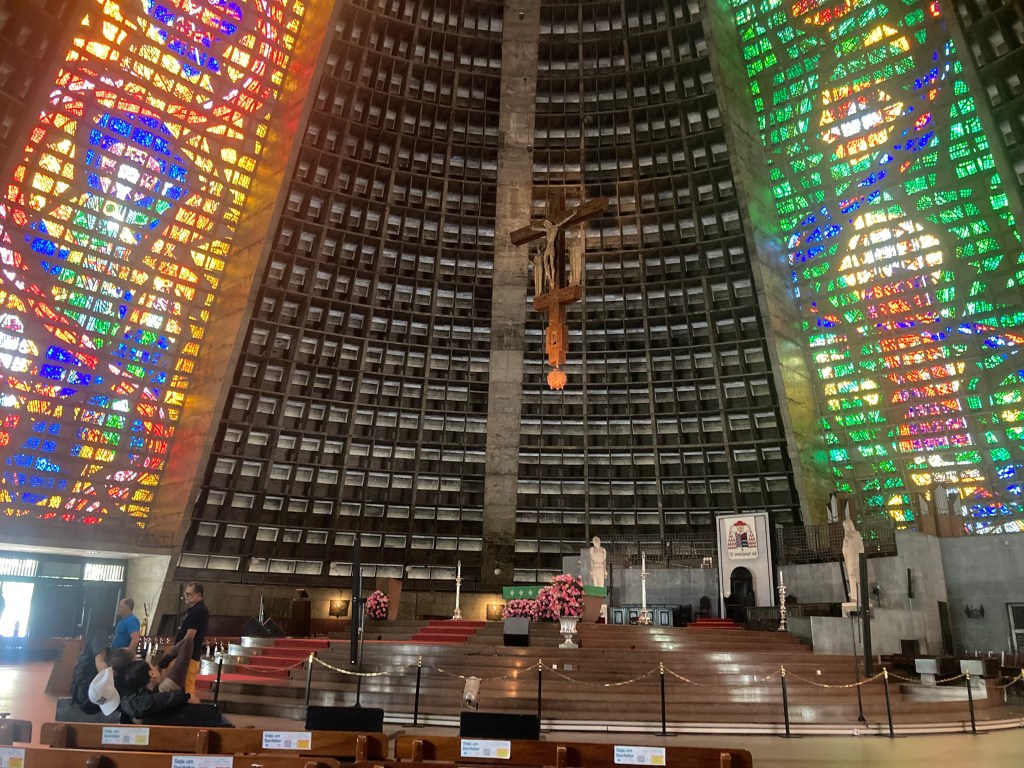
Exiting the delightful cathedral, I took a quick look at the Municipal Theatre, but couldn’t go in with my backpack. I didn’t mind though, as the journey gave me an excuse to explore Rio’s more metropolitan character. I backtracked to the Escadaria Selarón, one of the most famous staircases on the planet. Dozens of tourists congregated at the bottom, squeezing past one another to get their photos and videos. I left them to it, hoping when I returned the mob would have thinned.
Just down the road was Bar da Irene, where I ordered chicken parmigiana and a fruit smoothie. I took my table and observed an elderly woman barbecuing meat in the middle of the road for customers. I missed a trick really, to try some authentic street churrasco. You can get some great food around the Escadaria, but it may cost you a little chunk of peace, i.e. homeless people coming right up to your table.
My parmigiana came with rice, chips, farofa and black beans. The Brazilians love to carb up the plate and I, for one, don’t mind it. The smoothie was refreshing, but not as memorable as those served on the beaches.
The Escadaria Selarón had cleared out after lunch. Contrasting the surrounding terraced homes with its bold red and yellow paint, it really looks like something plucked out of a palace from times forgotten. Many of the manmade beauties in Brazil have a degree of extravagance I’ve not yet found elsewhere, which speaks to the uniqueness of Latin-American people.


I got a little lost on my way to the Parque das Ruínas (Ruins Park). Eventually I found it, but it can be attributed to dumb luck that I didn’t come unstuck in some shady-looking areas I passed on the way. Many Gringos live to regret sauntering around Lapa without their bearings.
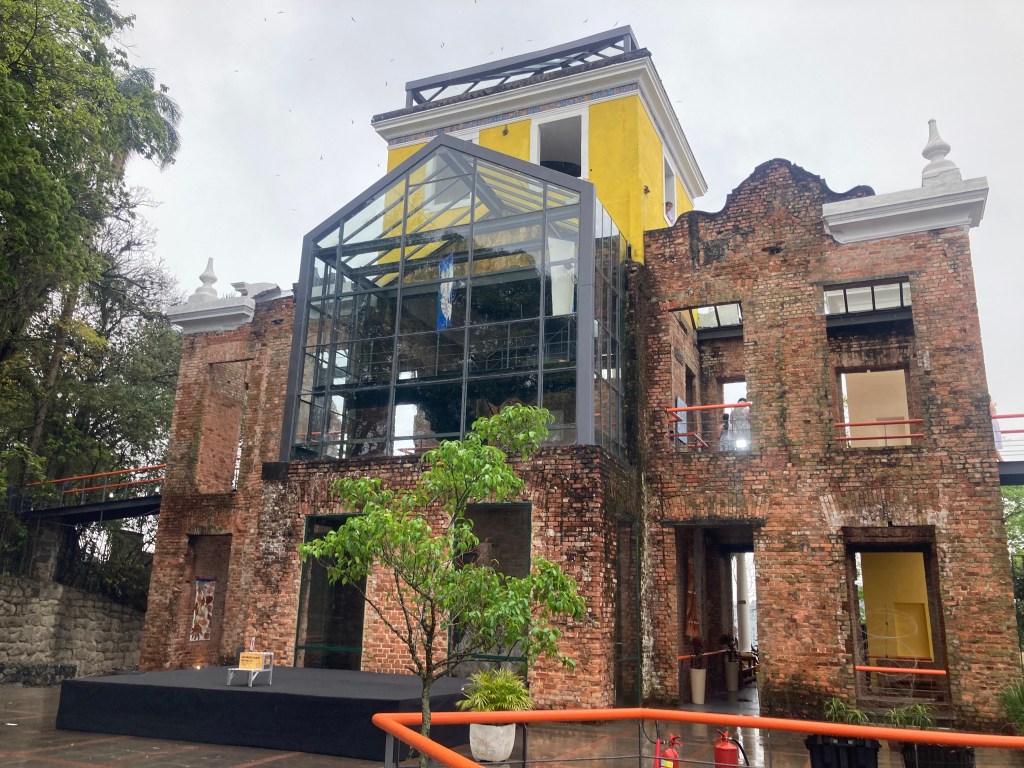
Parque das Ruínas: an art gallery built in the crumbled remains of a mansion in Santa Teresa. Super serene location with what would have been fantastic views of Rio were it not for the clouds and fog.
Even more intriguing is the Museu do Amanhã in Rio’s most northeastern corner. From the water jumps a giant white whale… or so the museum’s quirky design would have you believe. Inside are collections of science-themed experiences – Virtual reality and all that jazz. Pre-ordering tickets or showing up early doors is recommended though. Even on a rainy day, the museum will be rammed.

By way of Tinder, I was invited for a drink with a Carioca and her mate. The date had more of a friendship than romantic vibe, but was well worth my time. We met at a bar in Ipanema and had a caipirinha each. A multitude of flavours were on the menu, but I stuck with the original lime caipirinha for my first ever authentic Brazilian tipple. The bartender added some coconut milk, which is a common accessory. The idea I can get behind, but it burns the throat, and to me it tastes better without.
We went to a supermarket after that and sat in the café. I poured a dash from their vodka bottle into my pepsi, but they practically finished it between themselves as we went back and forth in Portuguese and English.
We walked through Ipanema to a nearby Boteco Belmonte. Ambling through one of the more notorious spots for robberies had me on my guard, but the streets of Ipanema were surprisingly empty. We arrived at the Belmonte around 10-11 pm. Wrong was I to expect a quiet little spot for a night cap; the place was jumping. Of course, masses of people are out partying every day of the week in Rio, but Brazilian culture also brings oodles of people to restaurants where they sip casual drinks and eat together. Like the beach culture of Brazil, it has a highly social and inclusive sentiment to it. TVs were playing jogos de futebol (footy matches) and waiters flew around, depositing food and drink on tables. The girl ordered a plate of loaded fries for us, but it wasn’t enough to sober up her friend. At one point he thought he’d lost his umbrella, and bellowed loud enough for the entire restaurant to hear:
‘Guarda-chuva, psshew!’
A ‘guarda-chuva’ (rain-guard) is an umbrella, and ‘psshew’ is something I heard once or twice in Ceará, but was far more common amongst Cariocas. Though it sounds like an imitation of a laser gun firing, it’s a noise people make to get somebody’s attention – the Brazilian equivalent to ‘Psst!’ but comes across more like ‘Oi!’
One of the waiters assumed the psshew was for him and did not take it too well. Me and the girl struggled not to laugh in embarrassment, and every time that waiter passed our table, I could see in his eyes the urge to elbow-drop our mate.
The friend went to the toilet to be sick for an hour, giving me and my date some privacy. Top wingman. She told me how waves of foreigners come to Rio hoping to get with a Brazilian for a night, and how this messes up the dating scene as both Brazilians and Gringos end up getting taken advantage of. She also accused a girl on the table behind us of being a ‘Maria Passaporte’, meaning ‘Married Passport’ or ‘Marrying for a Passport.’ It’s a derogatory term for Brazilian girls who frequent Gringo bars (hangouts known for attracting foreigners) hoping to pull a Gringo in order to acquire a visa or citizenship.
When I left, sometime around midnight, the Belmonte showed no sign of slowing down. And this was Sunday: A school night!
I’m sorry if the ‘Maria Passaporte’ thing disappoints or offends anyone, but I’m sharing with you the truth of my time in Rio. Uncle Tom is not letting his readers go to Brazil lacking intel needed to stay safe. It hasn’t changed how I view Brazilians; they’re still my favourite people in the whole wide world.
Moreover, my date paid the bill at the restaurant and paid for my Uber home, refusing to accept any dough from me. So, whilst it is commonly expected in Brazilian culture for the man to pay on a date, there are exceptions. “Para o Gringo,” on this occasion, it was not “mais caro.”
Day Three
Glad I’d only had one caipirinha when I awoke, I had Copacabana on my mind. The rain had mostly let up, but the bleak skies hadn’t really budged since the day before. Alas, I popped down to the world-famous beach. Give the edge of the Copacabana boardwalk a wide berth, and never let your back face the road lest an opportunist takes a shine to your possessions. Barracas populate the boardwalk, ranging from cocktail bars to suave restaurants. Many of the Barracas come alive after sundown, but even on a rainy afternoon you may find a lively restaurant with a band playing. The fast was broken with a big ol’ steak, chips, eggs and farofa.

Loyal readers will know I’m a walker. No, that’s not a typo, (though I am that as well), but my plan for the day was simply to plod the length of the beach and see what I could find.
I made a remark on Instagram about how cool Rio’s mountains are, but I must do again here. For a city renowned for its beach and party culture, it blew me away with its mountain game, and the stunning mystique cast upon them by a ghostly blanket of fog. Tom the massive walker found himself on Praia do Leme, which discontinued at yet more tall, forested peaks. It seemed a great spot to pull up a pew.
I got a deckchair for R$10 which seemed a right steal. The guy who rented it to me brought the subject of conversation to refreshments. I accepted a smoothie. “Maracujá ou abacaxi” (passionfruit or pineapple) were mentioned, but before I could choose, he said: ‘How about both?’
A couple of minutes later I was bickin back, reading my book and drinking my passionfruit/pineapple smoothie. Like in Fortaleza, drinks on the beach were beyond exquisite. The weather swung between too warm to wear a shirt and too cold to take it off, not least when the rain returned. I went shirtless and just had to grit my chattering teeth when powerful gusts fell upon me, thankful they were strong enough to send the grim clouds packing and reveal Copacabana in all its glory. What a difference a bit of sunshine makes.

I should have known I was going to get shafted when I was told not to worry about the price of the drink, and like a silly gringo I didn’t ask until I’d emptied my cup. The total price was R$50 and the chair was R$10, so you do the math. Never forget, people: Para o Gringo…
I paid up and made my way back along the promenade, absorbing the colourful energy, watching games of futevôlei and beach tennis. The weather being notably cooler than Fortaleza permitted one to spend more than five minutes outdoors without losing all bodily fluids through sweat, and so detoured to a ‘padaria’ (bakery) in Ipanema. Rio has a selection of phenomenal bakeries that raise the standard far above somewhere you just pop in to grab an angel slice. They border on being restaurants of their own, great after-work watering-holes equalling the social standing of modern coffee shops. Of course, plenty of people go to bars after work too, but the appreciation for food in this country was tremendous. Brazilians live more for the moment than the material, and I’m all for it.
Day Four
Breakfast? A half-day tour of the city, which included the Cristo Redento (Christ the Redeemer) statue and Pão de Açúcar (Sugarloaf Mountain). Our guide said we picked the best possible day for it; the skies tend to be ultra clear the morning after a rainy day, so you get the clearest and furthest views.
Up into the mountains spiralled the road leading to the ticket office. Browsing souvenirs, I discovered an adequately abrupt sign outside the bathroom saying: ‘Don’t piss on the floor.’
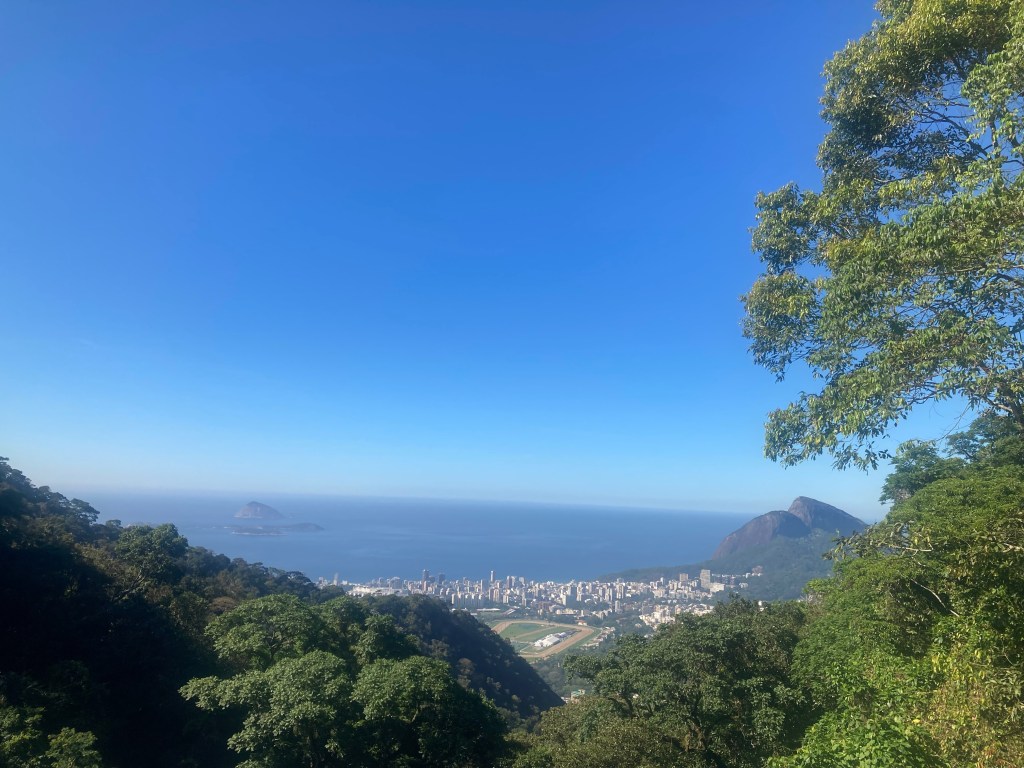

From the gift shop, an elevator carried us up to Cristo’s statue. The guide was cock-on about the weather: The past days of misery had detoxed the skies, and I had a hard time convincing myself that the views over the city were not figments of my imagination. It wasn’t the high season for tourism, but even so, it was a mission to weave between people and duck under selfie sticks so as not to photobomb.
When it comes to photos, I have a tactic: In Budapest and Vienna I mentioned my camera is a bit shite, so on occasions like these, if I notice somebody has a high-quality camera phone, I’ll nominate none other than Tom Hooke to take their picture, knowing they will return the favour. I used this here with a Colombian geezer called Carlos, and had a bit of a chinwag in Spanish. How many Brits can say they’ve practiced Spanish up in the gods under Cristo Redento’s watchful eye? He sent me them later and the picture resolution was pukka, though I looked a bit of a bot. Still IG-worthy.
Down to the carpark and back in the bus. It was time for Sugarloaf Mountain. On the journey we learned about the history of Rio and the term ‘Carioca’. ‘Rio de Janeiro’ literally means ‘River of January.’ Portuguese explorers arrived in Guanabara Bay on New Year’s Day in 1502. They mistook the Bay for a river, and so named it accordingly.
‘Carioca’ originates from around the same time, though its roots are ancient. Tupi was the language spoken by native tribes in Brazil whom inhabited the region now known as Rio de Janeiro. Carioca was a name they coined for the European settlers who rocked up and built their houses on the shores. ‘Kara’i’ (Cari) comes from a Tupi word that translates to white face or white man, whilst ‘oka’ (oca) means house, so Carioca originally meant house of the white face. Nowadays it’s officially a name for people from Rio, the same way people from London are ‘Londoners’ and people from New York are ‘New-Yorkers’. People from the State of Rio de Janeiro are ‘Fluminenses’, yet only those born in the city of Rio can be correctly referred to as ‘Cariocas’.
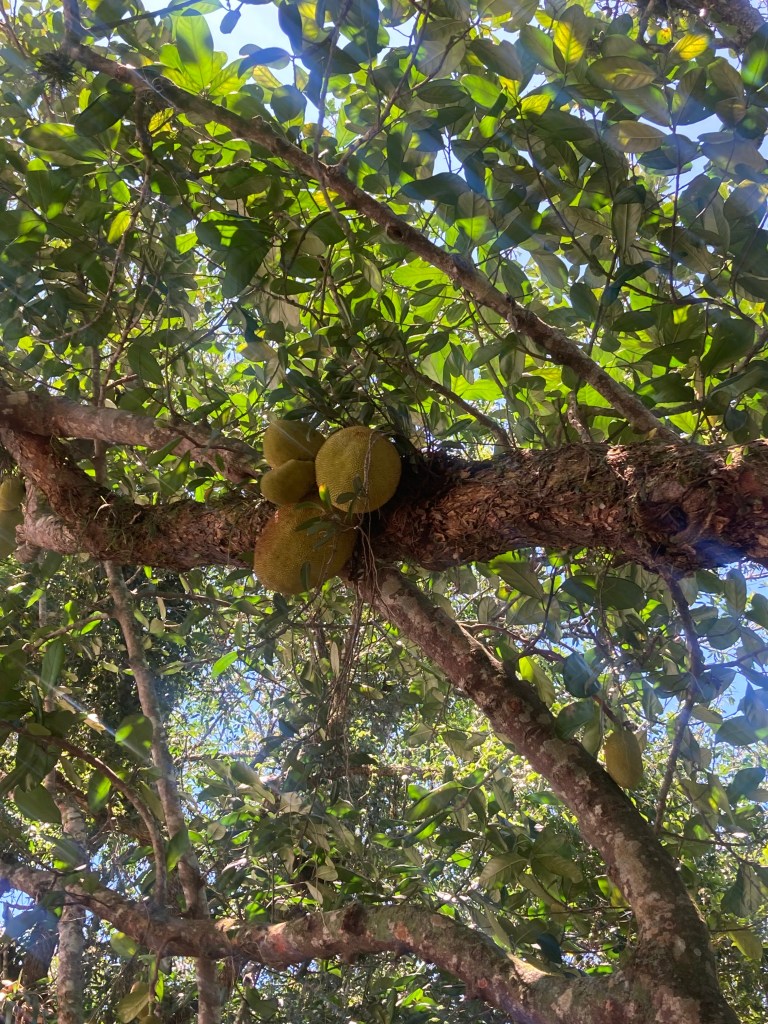
From the carpark at Sugarloaf we took to wooden walkways in the treetops, where dangled exotic fruits and little monkeys. We joined a queue for the cable-cars made up of mostly Latino tourists and schoolchildren on trips.
I can vouch that the cable car, whilst suspending you over a devastating drop, is a comfy ride that doesn’t swing too much, and allows opportunity to lose oneself in Rio’s landscapes from new angles.

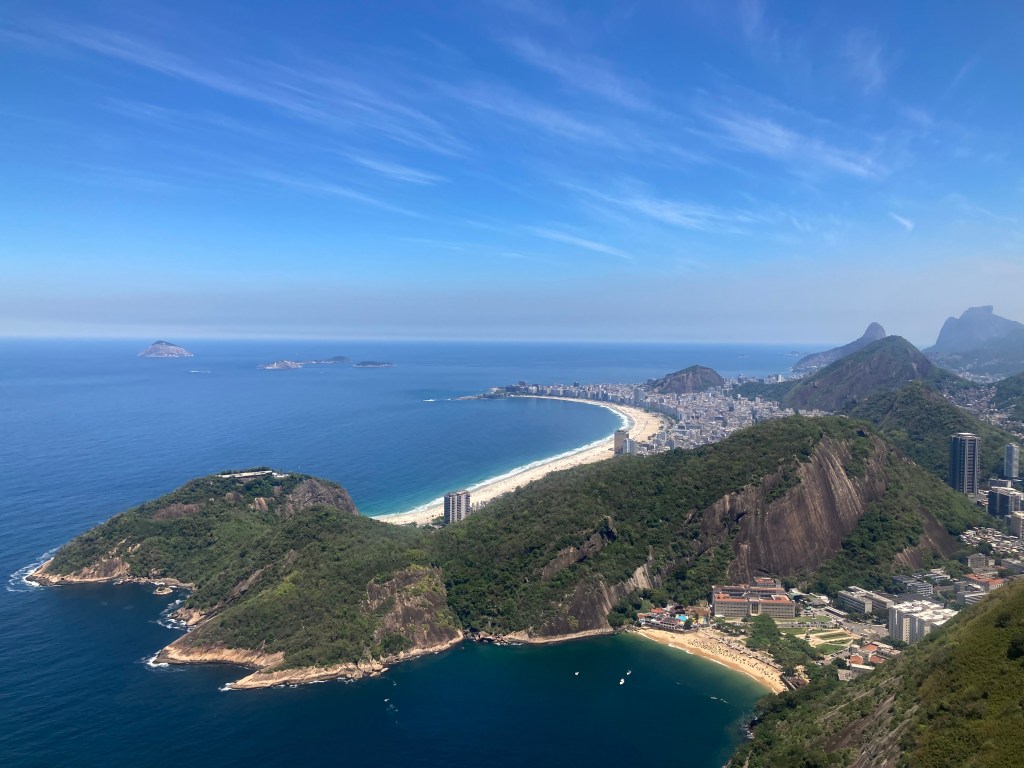
Exiting the car, we were herded away from the cable car and onto the viewing deck. I did the rounds once more: views, videos, and verifying who had the best camera so I could selflessly take their picture. It was roughly midday at this point, arguably the worst time for aesthetic photos due to the positioning of the sun. If capturing the perfect shot is your priority, get to Pão de Açúcar either before 11AM or after 3PM. I nabbed an ice-cream once I was done pootling around and sat with my group, divulging travel plans for 2025. The time eventually came to get a cable car down. Our spot in the queue was banked by the guide to save us joining from the back and waiting in the sun’s unrelenting glare. On the way down more cute monkeys one could easily mistake for well-groomed gremlins came to say hello.
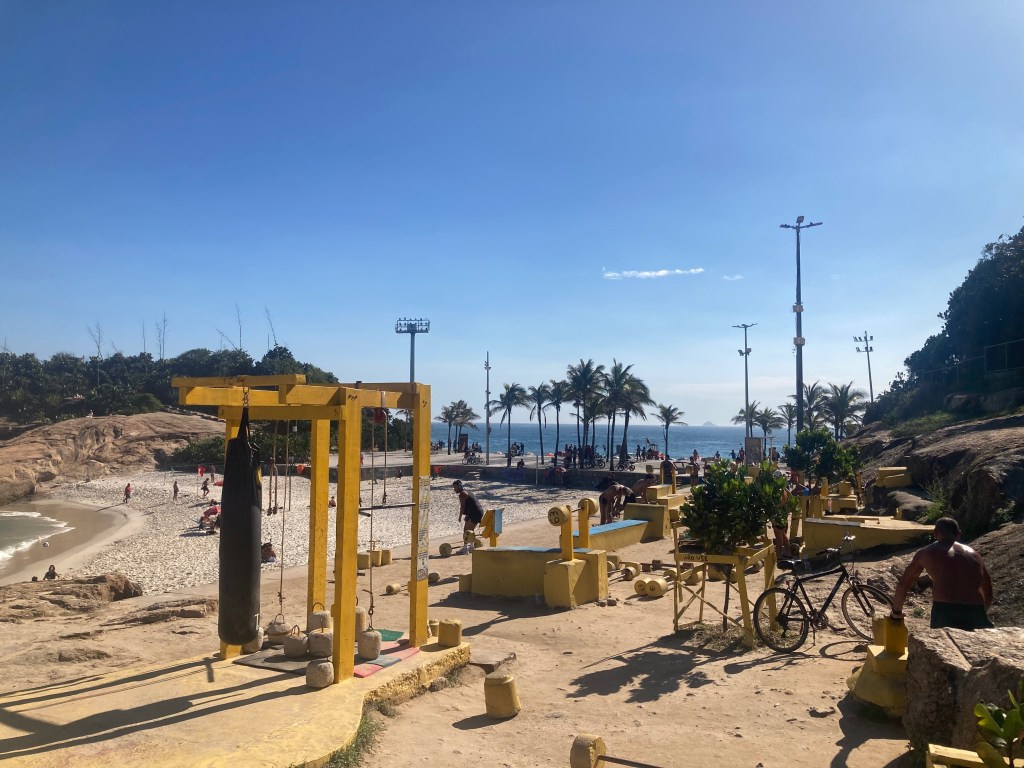
Those who had opted for a full-day tour stayed on the bus, but I got dropped off at Copacabana and went straight for Arpoador, in the corner between the Copa and Ipanema beaches. I wasn’t the only one who wanted to hit the sand, either. Blessed with good weather for the first time that week, citizens and visitors alike snatched their opportunity. Arpoador has a free outdoor gym right by the beach. All free weights are metal bars with lumps of concrete at the ends, and benches, pull-up bars and a little calisthenics apparatus are all at the public’s disposal. Everything you need to smash a good workout, with boatloads of scantily-clad women supplying that pre-workout caffeine.

Post-workout munch was seafood linguine at an Italian restaurant next to Ipanema beach. Really good grub, but I shan’t blame you if you scorn me for not getting local food from vendors along the promenade.
I yammed açaí for dinner and finished off with berries and yoghurt. You’d be flabbergasted at how much sweet, non-solid food I can ingest without getting bored.
Day Five
Eduardo was a top bloke. He picked me up early doors in the morrow, along with three American girls and a French couple, and drove to Tijuca Forest for a hike. Guiding us through Rio’s famous national park, Eduardo pointed out monkeys chilling in the trees and shared facts about local wildlife. The temperature was above twenty-five degrees, but the forest was quite cool. Trekking Tijuca during summer was much less pleasant, Eduardo assured us.
The first viewpoint we came to has to be one of the finest in all of Brazil. We found ourselves atop a mountain with the Marvellous City on one side, and acres of forest and lagoon on the other.
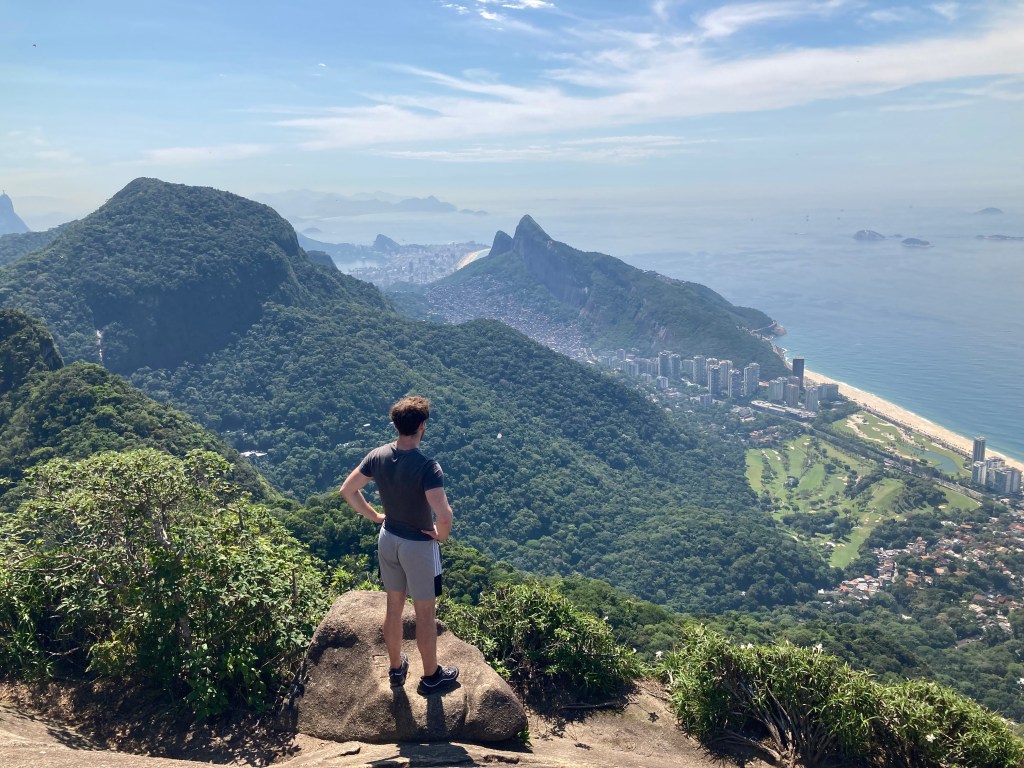
Again, it stumped me how much natural beauty lay just beyond the city walls. I can’t help chuckling as I recall Eduardo grabbing the French bloke by the wrist and yanking him towards the edge to take a photo of him, and the look on his wife’s face as her husband neared a sheer drop.

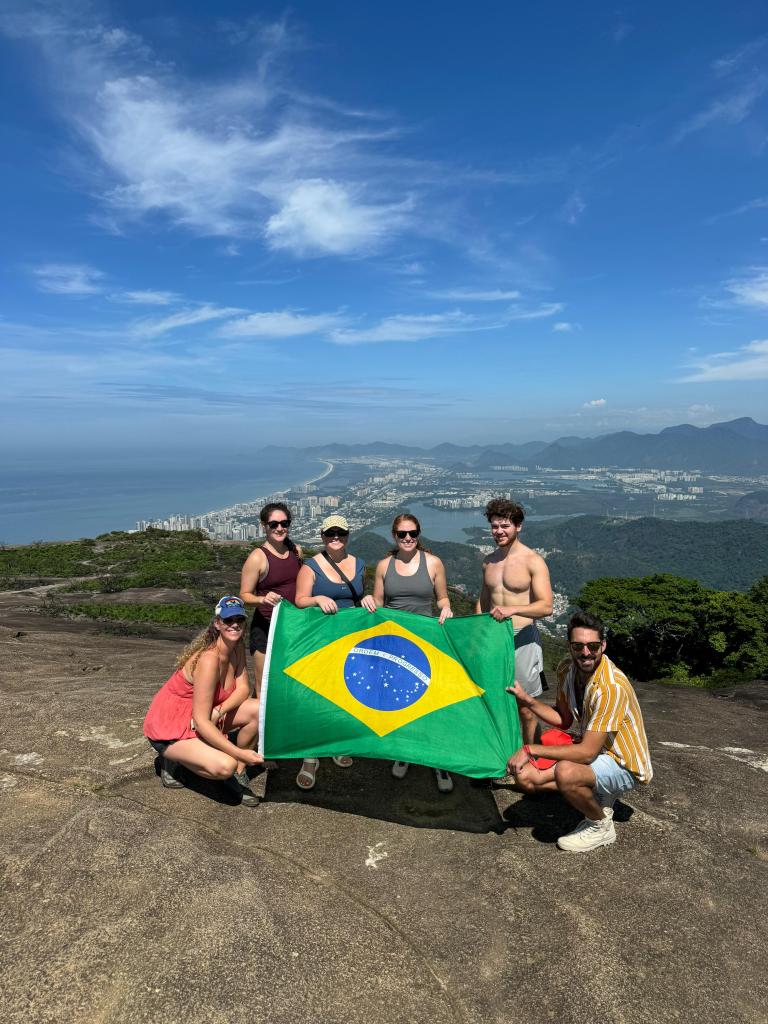
Next, we de-elevated through Tijuca and took a brief drive to the Largo da Cascatinha Taunay, where a grand waterfall reared it’s pretty face from between the trees, and trails spouted off the beaten track down to rock pools and streams.
As morning matured and the air grew humid, we came to one crude pyramid of jagged stone. At its base, an opening just wide enough for a person to squeeze through. Upon entering, we were enveloped in darkness and a cold vacuum. Creeping deeper, the pitch black was defeated by holes letting in sunlight, but the cool air, much to our delight, remained. We relished the change in temperature whilst Eduardo played Spielberg, telling us where to stand and at what angle for the best photos.
In the afternoon, I returned to Ipanema to watch the sunset from the Pedra do Arpoador. Readers with mobility issues beware, it’s not easy getting up or down from the viewpoint, and your arse will be numb by the time it’s over. The Pedra is a gigantic rock in the sea, separating Ipanema from Arpoador beach. It’s a regular gathering spot where Cariocas and non-Cariocas alike scale the slippery surface to say goodnight to the bright orb in the sky. I went up around an hour before sunset as I knew spaces would quickly become scarce. Even so, I wasn’t alone when I took my seat. One has two options to get there: either parkouring their way up a steep slope round the back, or going from Ipanema beach and playing hopscotch across the rocks. Sit on a towel or something that will create friction between yourself and the rock, because there’s nowt worse than slowly skidding down on your jacksy whilst others watch, powerless to help.
Anywhooo, I got seated and read my book as bodies filled the gaps around me. A group of lads with cheetah-style blonde streaks in their hair were at the bottom of the rocks, blasting Brazilian tunes from speakers and serving drinks to passers-by. I noticed – particularly in Rio – the blonde-streak trend, and to be fair to Brasileiros, they don’t half pull it off.
Refreshment vendors also joined us on the rocks, walking up and down like mountain goats and peddling bevvies. One salesman who haunts my memory, a fellow sporting a Heineken hat, was Psshew-ing like his life depended on it, angrily calling ‘Agua!’ and ‘Cerveja!’ as if they were his misbehaving children.
Literally the entire sunset, all I heard was: “Psshew! Agua, Cerveja!”
When I reflect on it, I somewhat miss that guy. Admittedly, far less than I miss the sense of togetherness on the Pedra do Arpoador, and the falling rays of light encasing Ipanema in gold. My first twenty-four hours of solitude were but a distant memory.
Day Six
Creating food is almost as much a passion of mine as consuming it. Thus, it was only right to round off Rio with a cooking class. A big obrigado to Cook in Rio (link in itinerary).
I met the chef outside a supermarket in Ipanema, and he took me around the shop to pick up groceries we’d need for the class. One of those was cachaça, a spirit made from sugarcane juice, used in the making of caipirinha. If you want to get your hands on some in Brazil, I was apprised that supermarkets do better deals than duty-free in airports.
After picking up a few ingredients we walked to the kitchen, situated in a small shopping centre. I exchanged pleasantries with the chef’s assistant, and then an American guy joined us. His first question was which “soccer” team I supported. My answer was Leicester, and he gave a disparaging wave, pledging allegiance to Chelsea. At least he didn’t go for Man U or Liverpool. Despite getting off on a weird note, I believed this Yank was actually a good bloke, and the universe wanted to see if I had the patience to uncover his more likeable side. It probably helped that the first thing we made was caipirinha. The head chef whipped out the cachaça bottle and explained we would use it to make the famous Brazilian cocktail. However, first he encouraged that we shot it straight, with no mixer. It ended up being one of many shots of cachaça I ingested, so forgive me if I err when reciting recipes.
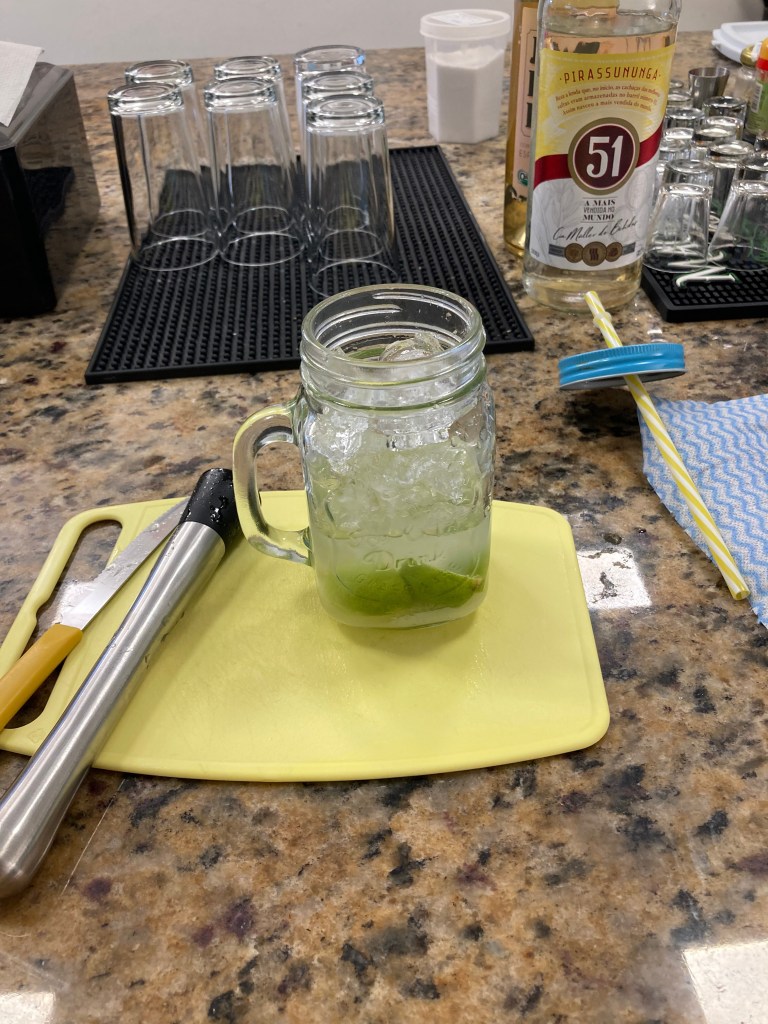
After our shots, we were each given a jar, a little bowl of (potentially brown) sugar, and a lime. The lime, I chopped in half and squeezed into the jar, along with two tablespoons of sugar. The next instruction was to take a pestle and mash the two together until the sugar was infused with lime-juice. Those steps complete, I poured in a double shot of cachaça, filled the jar halfway with ice, slapped the lid on, and shook it like it owed me money. Finally, I stuck a straw in to slurp what was easily the most perfect caipirinha I’d ever tried. I much prefer it with plenty of sugar, and no coconut milk for a sweet, soothing concoction.
I’d refrained from eating all day to save room for the food we would cook, and two or three caipis slid down the hatch before a morsel of food. The end result was me getting bladdered on cachaça. Good thing I took photos and videos during class, as I don’t really remember any of what happened.
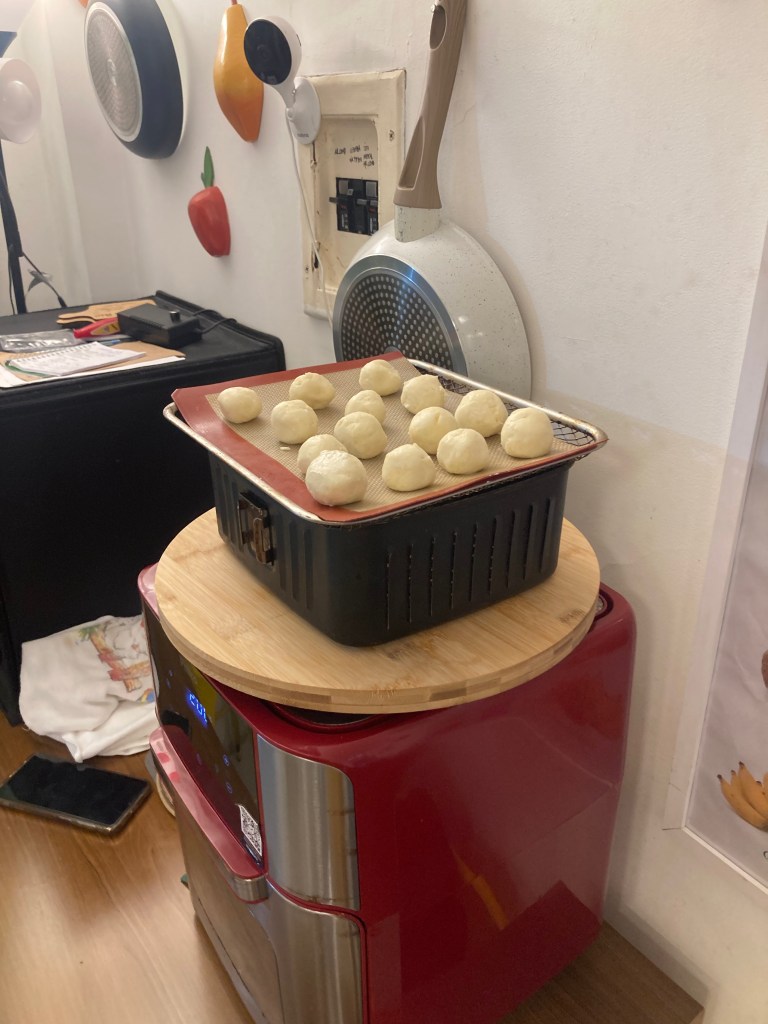
Next, we prepped one of the most beloved snacks/party foods in all of Brazil: Pão de queijo. Literally translated to “cheese bread”, it is a ball of cheese (duh) and tapioca flour. This flour comes from the cassava plant, which proved a key ingredient throughout our class. We rolled a series of little pão de queijo balls and slapped them in the air-fryer to bake. There were so many that we had to bake them in two separate batches.
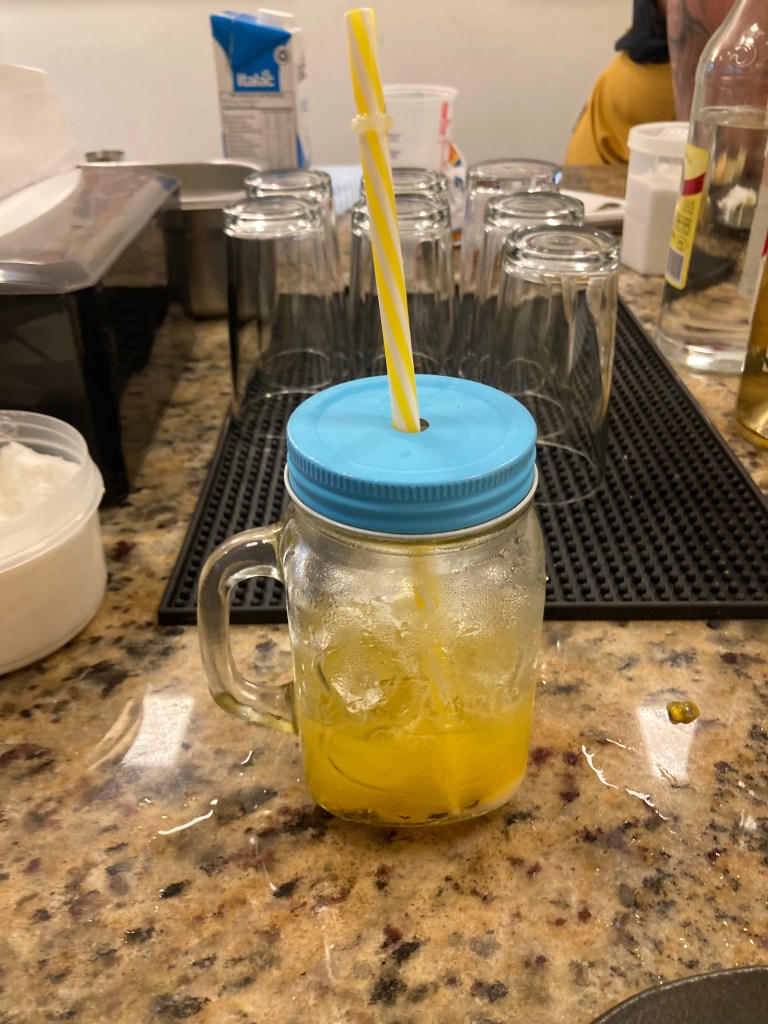
Between dishes, the assistant chef deposited half a passionfruit on our chopping boards so we could top up our caipirinhas with a new flavour. I’m not especially patient when it comes to nursing my drink, and passionfruit caipi tasted so good that I sipped it relentlessly whilst we again utilised the flour, this time to make Tapioca pancakes. These took on the appearance of a prawn cracker, with the flexibility of a tortilla. Myself and the Yank took turns flipping ours in the frying pan, then served them up savoury with tomatoes and herbs.
The air-fryer dinged and we took a break from cooking to wolf down tapioca and pão de queijo. We then boiled and ate some chopped cassava whilst the second batch of pão de queijo was baking.


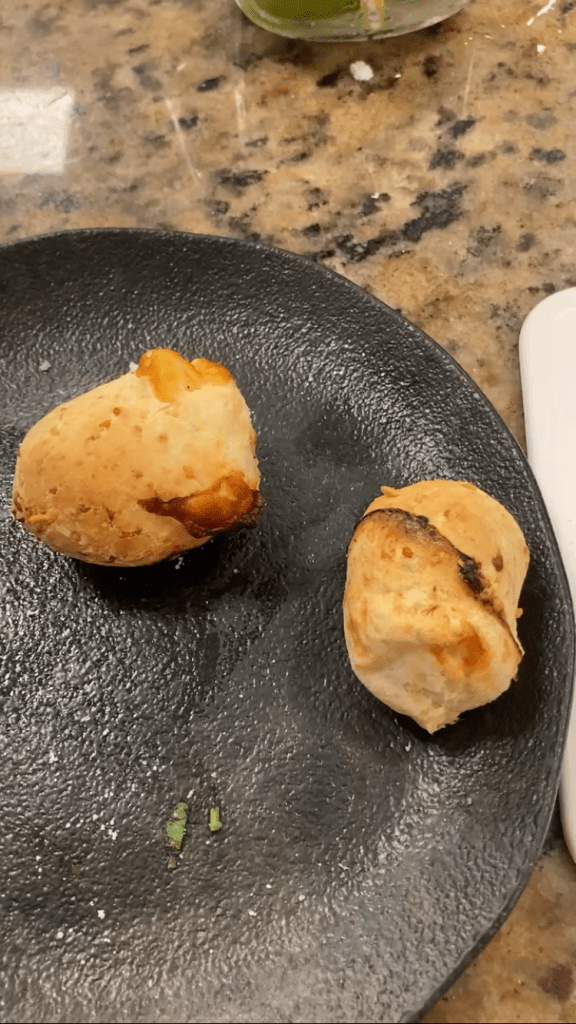
Left to right: Tapioca, cassava, pão de queijo
Time came to prep the brigadeiro, using butter, condensed milk, cocoa powder and choccy sprinkles. Created in the 1940s, legend has it the confection was named in support of Brazilian Air Force Brigadier General Eduardo Gomes, during his presidency campaign. We whipped up the mixture and formed it into a series of balls, like we did with the pão de queijo. Those balls were doused in the chocolate sprinkles and stored in the freezer. The head chef pulled out a big beef rump, which we were to turn into picanha. The American lad, an avid steak lover and son of a butcher, was overcame with excitement. He said não mais to pão de queijo in order to save space for the picanha. Poor old Tom had to pick up his slack and eat it all himself.

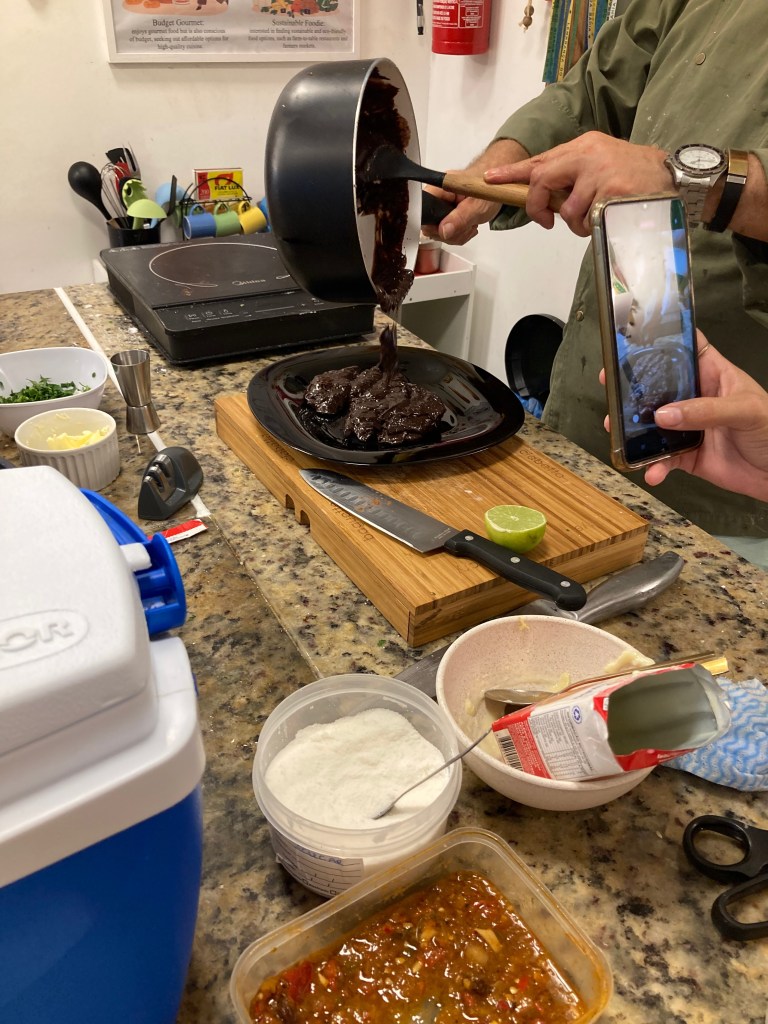
Yankee assisted head chef with the picanha whilst I tended to a banana farofa. You can find the full recipe on Cook In Rio’s website, but essentially the banana and cassava flour were toasted and tossed together. There may have been some brown onion in there as well, but I was seven cachaças deep by this point so don’t quote me. Following the farofa, I made a salsa from pepper and tomatoes (or, so my photos suggest – again, seven cachaças).
Once the steak was cooked to medium-rare, we piled it all together on a plate. Picanha tends to be a bit fattier than other cuts which means it holds the juices and flavours better. The tender meat infused perfectly with the salsa and farofa. We needed no extra sauces or condiments; it was absolute joga bonito without.


I polished that off, and the pão de queijo, and probably whatever else was leftover. The brigadeiro had set in the freezer by the time I was done scavenging, so we had an unreal dessert to cap things off. I gladly recorded a video testimonial for Cook in Rio, and they are my GOAT cooking class to this day.
I polished that off, and the pão de queijo, and probably whatever else was leftover. The brigadeiro had set in the freezer by the time I was done scavenging, so we had an unreal dessert to cap things off. I gladly recorded a video testimonial for Cook in Rio, and they are my GOAT cooking class to this day.
Outside in the fresh air, I clocked I was still spangled from the cachaça. Belly aching, and on the brink of a food coma, I opted to wait out my lethargic state on the beach. Writing these blogs has made me realise just how much time I spend in food comas, and what better way to spend life?
Rio was grey again, and Ipanema pleasantly cool and uncrowded. I lay on my towel in the soft sand, shut my eyes, and…
“Psshew! Agua! Cerveja!”
Nooooooo…
I couldn’t believe that bastard in the Heineken hat was here. It’s all a dream, Tom, I told myself. He’s not real, he can’t hurt you.
“Agua! Cerveja! Psshew!’
I couldn’t pretend to ignore him. Heineken hat was back, and with him came more rain. The heavens opened big time whilst I was on the beach, so I dashed back to my gaff, a tired, sodden, drunken Brit. So full was I that I only had a bit of yoghurt for tea. Maybe a pizza and chips too. But yeah, that cooking class was the horse’s berdoobers.
Day Seven
Friday began with an upper body workout at the Arpoador gym, followed by a surfing lesson. I had taken one surfing lesson before on Bondi beach in Sydney, but probably didn’t retain much in the fifteen months since. My instructor, Luca, was a sound guy. He knew enough English and I enough Portuguese for me to understand his tips and pointers. I also managed to stand up on the board, which I hadn’t been able to do on Bondi. That said, I would suggest Aus over Brazil for surfing lessons, as in Australia you’re more likely to find instructors who are tried and tested in competition, and save yourself the trouble of learning Portuguese.
Conclusion
English- or Spanish-speakers can get by in Rio without knowing Portuguese. It’s so touristy that many staff in restaurants or at attractions will understand one or the other. Consequently, I felt less immersed than I did in Fortaleza, where lack of spoken English forced me to adapt. In Rio that pressure simply wasn’t there.
It goes without saying that Rio has plenty more to do than Fortaleza, and (contrary to my expectation) was my favourite of the two cities. I love places that have loads going on, even if I’m not involved in it, and I was truly enraptured by Rio’s warm, welcoming vibe. I know I bang on about how friendly Brazilians are, but honestly, that city has something in the air that I’ve never experienced elsewhere. It’s a sensation of just being accepted and loved, every place you go, every minute of the day. Granted, if you’re somebody who went to Brazil, wandered too close to a favela, and got robbed at gunpoint, you might see it differently, but Rio made me feel wanted like nowhere else.
Dating/Social
Similarly to Fortaleza, I had much better return on investment from Tinder and Hinge, scoring a date through the former. Again, I wasn’t exempt from the usual laws of dating apps, (i.e. people timewasting) but I don’t want to reiterate what was already said in Fortaleza.
The date that I did go on was a great time. Brazilians know how to kill awkwardness, and strike a perfect balance between being chatty, and being great listeners. She also sponsored my night out without asking anything in return. I guess it pays to be this handsome.
Whilst I didn’t Samba, bop, griddy, or two-step and a chicken wing, the nightlife in Rio needs no introduction. The outgoing nature of the Brazilians makes them very approachable, so meeting new people at bars or parties will be more natural and fun than most other countries you’ve experienced. Simultaneously, please heed the warnings I shared throughout this blog. Avoid travelling on foot at night where possible, and if at a block party, get your drinks from trusted vendors, not random folk on the streets.
Samba lessons would be on my to-do list if I went again. The American from my cooking class told me about his, and said afterwards the class went to Lapa for a Samba party, where he met his then girlfriend. He said there was a language barrier between them, but I guess they overcame it with kinetic energy. I just hope she managed to convince him that, like in the other hundred and ninety-something countries, it’s football, not soccer.
Food
Rio more or less matches Lisbon for quality in bakeries. The sandwich game perhaps not so much, but I would say it’s on par for anything sweet. Yes, Portugal has the Pastel de Nata, but quality across each nation’s repertoire is fairly equal.
Having eaten so much street food in Fortaleza, I didn’t repeat the process in Rio. I should’ve done, so I could compare them now. Though I cannot rank one above the other for taste, Fortaleza’s selection included more unique northeastern foods, such as acarajé, and so that was my preferred city for street grub. Around Copacabana and Ipanema you’ll find heaps of eateries where you can get traditional cuisine like feijoada and picanha. I found Barraca restaurants in Copa to be hit and miss. Ipanema had higher quality.
Churrasco, churrasco, churrasco. Whilst in Rio, you must try some authentic Brazilian barbecue. Rodizio is my favourite kind, where waiters bring around skewers of meat, giving you a taste of everything. You pay a fixed price, and eat until you can eat no more.
Smoothies and açaí were a highlight like they were in Fortaleza. Brilliant as the açaí was, it didn’t trump that which I’ve had outside of Brazil. Those smoothies, on the other hand, were incomparable from any beverage ever to grace my tastebuds. Brazilian beach smoothies definitely make the menu for my death row meal.
My number one culinary experience – and number one activity overall – was Cook in Rio’s cooking class. Whether a foodie or not, your attendance will be rewarded with great food, intriguing lessons in culture, and bottomless caipis.
Thanks for reading, and I hope you’re taking good care of yourself.
Sincerely,
Tom Hooke
How Tom Got Around
- Saturday 19th
- Arrival and check-in
- Sunday 20th
- Arcos da Lapa
- Catedral Metropolitana
- Escadaria Selarón
- Date night in Ipanema
- Monday 21st
- Copacabana beach
- Copacabana beach
- Tuesday 22nd
- Cristo Redento
- Pão de Açúcar
- Workout at Academia Publica do Arpoador
- Wednesday 23rd
- Tijuca Forest
- Sunset at Arpoador
- Thursday 24th
- Cook in Rio cooking class: https://canva.cookinrio.com/cook-in-rio?trackingCode=
- Cook in Rio cooking class: https://canva.cookinrio.com/cook-in-rio?trackingCode=
- Friday 25th
- Final workout at Arpoador
- Surfing lesson
- Journey home
 Tom Gets Around