Location(s): Fiji
Dates travelled: 29th June –29th July 2023
| Glossary* Youth = Fijians aged 17-35 whom we worked with on the build project. Key Youth = Group of girls from the Youth, all 19-21 years old, who organised the culture lessons for us, as well as participating on the build project. Key Youth can be plural or singular. Bulu = The clan my Fijian family belongs to. Each family belongs to a different clan. These clans also have different roles within the village. Bulu’s role is Sau-Turaga (Sub-chief). They are in charge of electing the village chief. N-City = The nickname given to the village by the Youth, and the one I will use to avoid disclosing its real name. Tailevu = One of Fiji’s 14 provinces and the one in which N-City is located. Na = “Mother” in Tailveu dialect. Nay = “Auntie” in Tailevu dialect. |
Nerves pricked my insides, swilling the ice-cream sundae I’d grabbed from a Fijian Maccy D’s around my stomach. In the five or so hours we’d been on the bus, and as the landscapes of rural Fiji had further enveloped us, our balloon of excitement whittled down to anxious reality. Not a cloud in the sky, but plenty in our minds. How would the village receive us? Would they like us? Love us?
‘One Step at a Time’ trickled through the bus speakers. Support acts had been a mashup of classic pop, reggae, and island tunes, but Jordin Sparks’ sweet melodies are the ones I associate with long, quiet roads surrounded by hectares of field, palm trees bursting from the forests to reach over and rattle the windows with their branches, and anticipation warring against the fatigue that weighed down everybody’s eyelids.
‘Is that the Village?’ one of the girls said.
Before Leader K had even confirmed it, my stomach went from sundae swiller to washing machine. We had arrived.
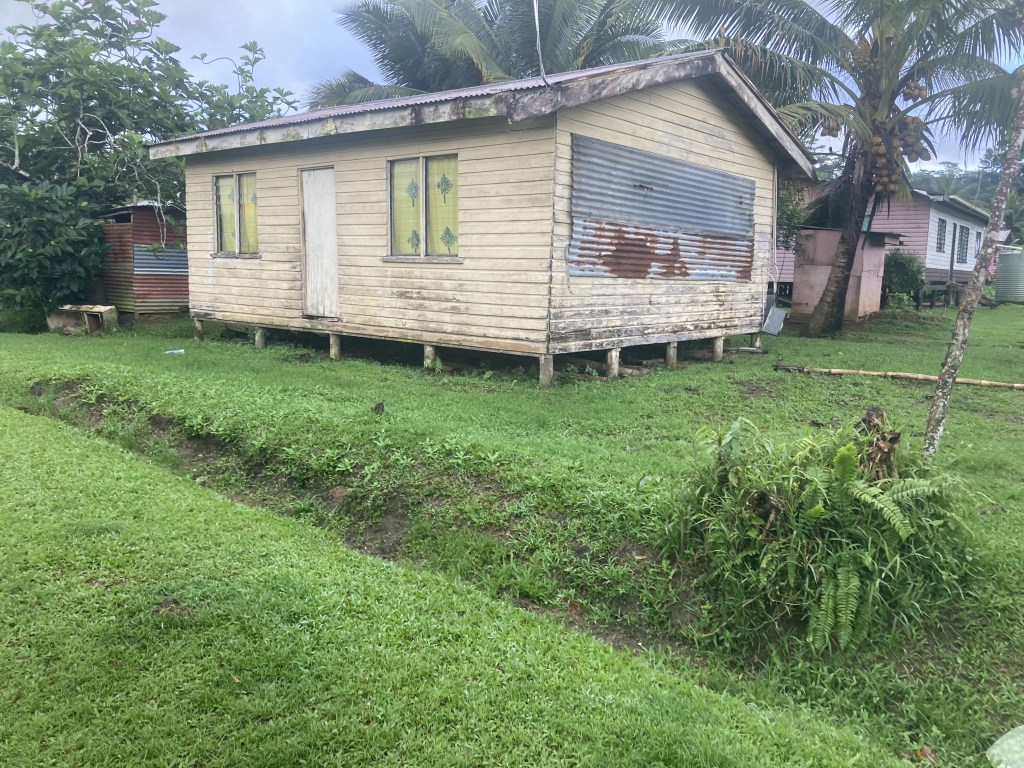
So long had we been on the empty roads, that the turn we took onto a dirt path felt like a jarred awakening. We’d seldom encountered human life for hours, and yet now, houses of timber boards or tin sheeting sprang up either side of us. Such houses were towards the bridge we stopped just shy of, but thickened in volume just past it.
We disembarked, the bus driver handing our luggage to us through the window. We unpacked our pink sulus as a boy came haring down the dirt road, pushing his friend in a wheelbarrow. They raked to a halt before us. The kid pushing the barrow stood staring as if entranced. I shook his hand and asked him his name.
‘Joshua,’ he answered so quickly I barely caught it.
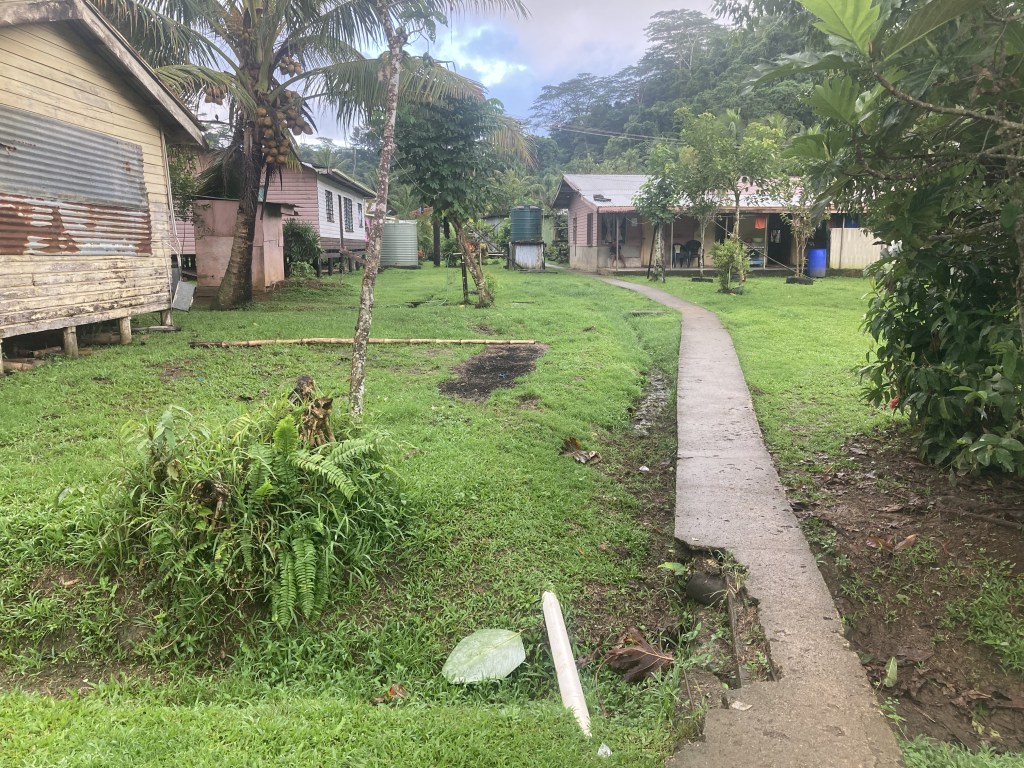
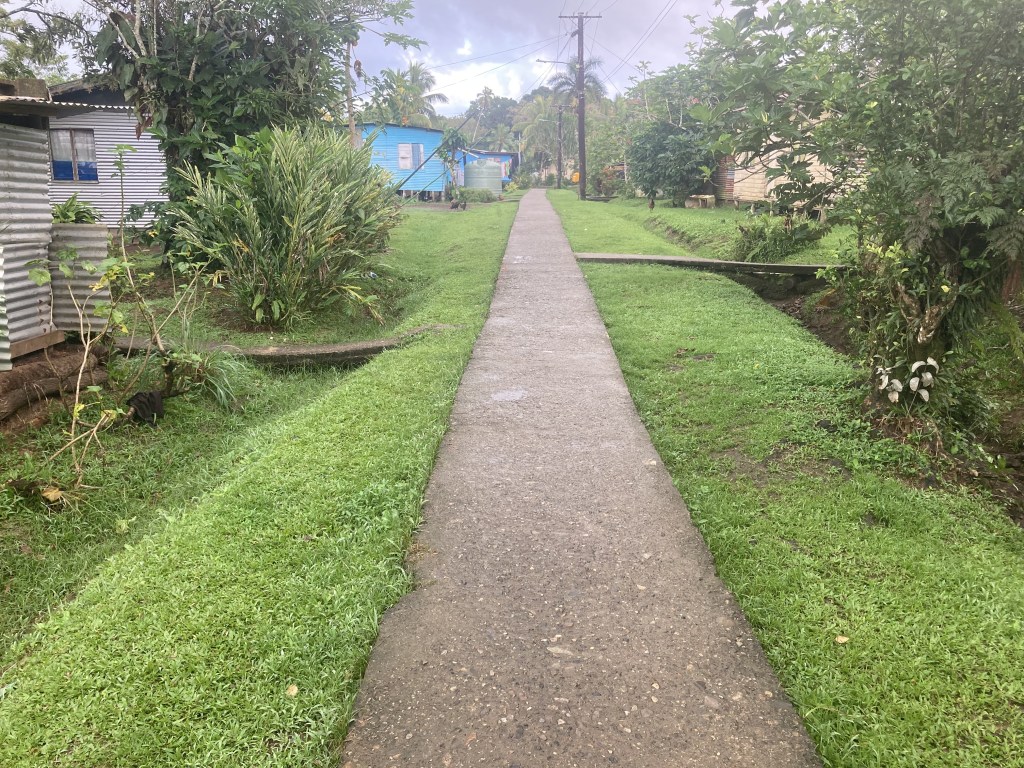
J helped me tie my sulu (I never did learn to do it properly) as Joshua crossed the bridge into N-City. We followed suit. Over the bridge were more bungalows amid the palm-tree jungle. Down the concrete footpath, across another bridge was a long, yellow building. The village hall.
Upon entry, villagers sat against the walls received us with warm, welcoming smiles. In the middle of the hall ran a long tablecloth. A hell of a spread had been laid for us. Not wanting our initiating meal to be too great a culture shock, the hardworking village women had prepared an assortment of cakes and sandwiches, as well as jugs of juice and tea.
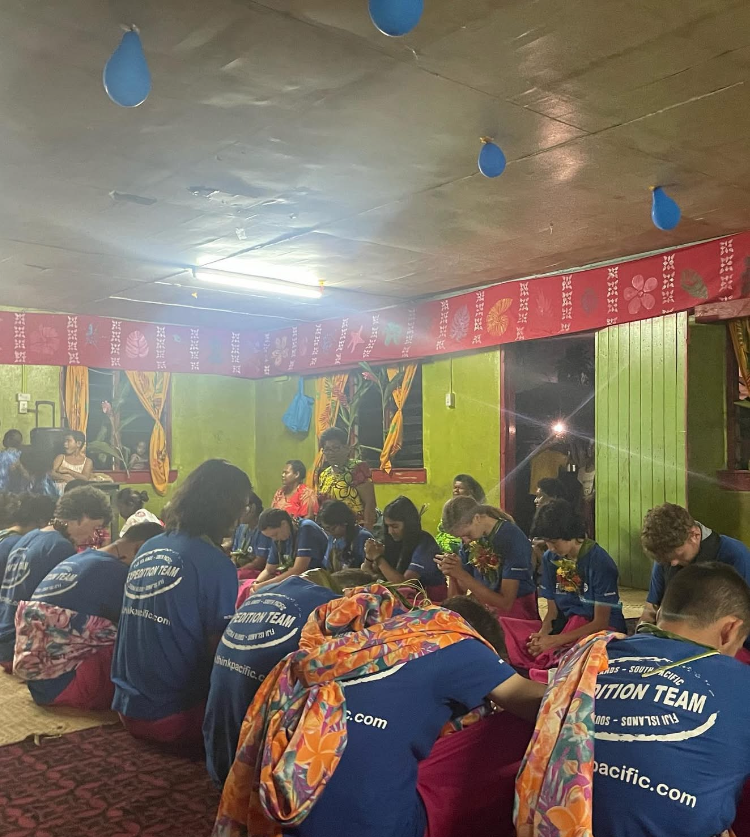
Quick note on terminology: Nay in Tailevu dialect means ‘auntie’, but people referred to the mothers around the village as the ‘nays’ in that each one was like an auntie to us (and in many cases were our aunts through marriage). It was the nays who provided the tea party, and watched gleefully as we shared our first feast.Younger faces peered in through doorways and windows. Occasionally, I’d make eye contact with one, and they’d quickly duck out. Soon, the plates were bare, and the music was turned up.
Still chewing my last mouthful, I felt a tap on my shoulder. No sooner had the hand left than a Nay was pulling me up for a boogie. We threaded an arm aroundeach other’s waist as we fed into a row of volunteers and Nays practically spanning the room, ready for a Fijian line dance. We shuffled forward and backward in time with the Fijian pop songs, laughing off the embarrassment.“Tap Charlie’s shoulder, tap Charlie’s shoulder!” one of the girls told me, and I would have if the hand not encircling a Nay hadn’t been the only thing keeping my sulu from falling around my ankles. The dancing went on for a few minutes, the entire room going into uproar every time someone did any kind of outlandish move. Dancing fully sober with strangers, on their turf, whilst their children point and laugh at you, is not something many can relate to. I reflect on it as a key character-building moment in my life.
The music died away and so began the Sevusevu. The chief, Headman, and village elders formed a row at one end. We sat before them in a horseshoe. Prior to any kava, volunteers took turns introducing themselves to N-City. One particularly chatty Aussie girl had done so much talking during our week in Sigatoka that she’d managed to lose her voice. It was mercilessly hoarse and kept cracking whilst she tried to talk, which had the room in stitches. I kept my intro to a minimum, hoping my voice didn’t betray me as the Sheila’s had, and keen to shift attention off me ASAP. All three leaders, including K, who is Irish, introduced themselves in Fijian tongue. Then came prayer time.
One of the elders kneeled, holding a paper-wrapped yaqona plant the way one would a guitar. His speech was solely in Fijian, but we later learned that it is common, after a long journey, for Fijians to thank God for guiding them to their destination and protecting them along the way. I imagine this was included somewhere in the prayer. Every so often the chief would softly respond “Vinaka”. Vinaka means thank you, so I assumed the Chief was thanking the man for the blessings wished upon the village and the project.
Then, the plant went away, and pre-ground yaqona was poured into a hessian sack, and the sack dipped in a bowl of water. The mixer (another elder) held the top of the sack with one hand to keep the powder from falling out (for the love of God, don’t let go of that), and with the other, strained the kava, meaning they squeezed the bottom of the bag where the powder had collected to mix it into the water.
Throughout the mixing ritual, the Chief keeps a constant watchful eye over the bowl, and if more kava or water needs adding, he’ll put a word in with the Headman, whom tells the man mixing. When the chief is ready for a bowl, he’ll call, “Taki!”
The kava was mixed and the bowls passed around to volunteers. Not everyone got a bowl; I believe we were running low on time and wanted to get the party kicked off.
After the Sevusevu we were sorted into our houses. Two boys or two girls to a house (no mixed groups), and one unit of three lads as we had odd numbers. We already knew who we’d been grouped with, the intention being to have us sharing a house with volunteers we hadn’t really got to know yet. I was paired with a young lad from Manchester whom would quickly become famous in N-City. We’ll call him Teri.
Our names were called and we tilou’d our way over to an elder lady wearing the most youthful smile imaginable. She bestowed upon each of us a flower garland,a hug, and a kiss on the cheek.I did my best to hug back affectionately whilst still holding up my sulu. We sat together by one of the doors whilst the remaining volunteers were assigned to their houses. For privacy purposes I will not say the name of my Na or the name of her house (each house in the village has its own name), but I can tell you we lived at ‘Oti oti ni vale’ (the last house). Streetlamps were few and far between, which is of little hinderance to Fijians, who, I guess, eat plenty of carrots. Torchlight was required, however, by mine and Teri’s westernised eyes.Noises from the village hall were soon replaced by chirping crickets and croaking frogs. Just before our house was another bridge over a small body of water where canoes moored up. Houses were sparse again this end of the village.Soon after the bridge we stopped at a bungalow with a neatly-trimmed grass lawn.With a creak,the front door opened and a dash of light spilled out. A face hung in the doorway. Even in the dim illumination, our older sister’s glee couldn’t be missed.
“Bula!” Teri cried.
She returned the Bula and beckoned us inside.
Their ‘vale’ (house) immediately had a homely feel to it. We’d been told that Fijians always sit cross-legged on the floor, however we found ourselves in a front room with armchairs and sofas. Our Na showed us to the next room behind a curtain, where she had set up two mattresses to sleep on with duvets for the chilly evenings.Later, visiting other homes in the village, we would see how rare such luxuries were, and made things like the neatly knotted curtains by the kitchen table seem an even more delicate touch. We were shown a pair of tin huts outside too, one being the toilet, the other, a shower.Despite our family’s insistence that we sit on the sofas, Teri and I went cross-legged on the floor. We were supposed to return to the hall for a huge welcoming party, but our sister asked if we’d like to stay home for a bit and head to the party later. We said sure, and they broke out the kava.
I already knew Teri wasn’t the shyest of the bunch, but he took the ladies by storm with his conversational tekkers. From sending our Na into fits of laughter with his quick wit to getting them blushing with his remarks about how beautiful the grandkids were, and that good looks must run in the family. Unfortunately, I did a poor job of matching his energy, and crawled deeper into my shell. I guess my logic was that I couldn’t really follow that up; not to mention that there could have been five volunteers in the house that night; Teri would have done enough talking for all of us. I knew I was being overly quiet when my new sister took initiative and literally asked me to speak about myself. I focused far too much on the gap between Teri’s energy and my own, and dropped into a vat of imposter syndrome. I spoke a bit about my family, but I couldn’t make them smile like Teri had.
We sat drinking bilo after bilo (bowl after bowl) of kava and indulging in stories.Na’s infectious laugh got me going as much as the tales about her grandchildren, who were technically my nieces and nephews. I forgot that I was only supposed to say “Bula” on my first bilo of kava, and by the fourth or fifth my sister, still laughing, told me I didn’t need to say hello every time I drank. Against Na’s wishes, we affirmed that we weren’t hungry and they needn’t cook for us. The fact that they offered gave us a glimpse into Fijian generosity. That deep-rooted mindset of “it’s no problem, we’ve got you.” Our sister’s husband (technically our new brother-in-law) joined us, and then a lady whom we were instructed to call ‘Nada’ (Nan-da).
“Here she comes, here she comes,” whispered our sister.
An elderly lady entered the house. Teri and I both said: “Bula, Nada!”
The ladies couldn’t contain their hysterics. The elderly woman was actually an auntie of ours, but Nada means ‘grandmother’. ‘Nada’ and ‘Bubu’ (mboom-boo) are both terms meaning ‘grandmother’. One is your maternal granny, and the other paternal. Don’t ask me which is which; dialect varies by province anyway, so your Nada in Tailevu could well be your Bubu in Rewa.
By the sixth or seventh bilo, we were beginning to feel the psychedelic effects. No hallucinations, just waves of fatigue. Every yawn took me to the brink of dozing off. I mulled the day’s events over as I set up my mozzy net and climbed into bed. For one thing, I was quite disappointed in myself for my lack of engagement and being so quiet. Making connections with others wasn’t coming naturally to me. I’d thrown obstacles in my own path to avoid interpersonal relations with volunteers, telling myself I’d fix things once I got to the village. Then, I went to the village, and barely said a word to my adoptive family. I resolved that I was waiting for things to happen for me. Existing not living. I’ve met a few people who spend their lives dormant, wrapped in a blanket of “I’ll just do it tomorrow,” and waiting for the wake-up call that never comes; the thought of being like that scared me. Was I choosing a similar fate?
The clanging of pots and pans woke me early the next morning. I knew what that would be.
I got up and popped my head out of the curtains drawn across our room. Lo and behold, Na was already putting something on the stove.
“Bula!” I said, wandering over.
“Bula,” she responded with a giggle. ‘Making breakfast.’
“Oh wow,” I said. “Thank you.”
She giggled again. Right old giggler, my Na. Of course, we knew to expect that our families would feed us, yet we never let gratitude go amiss. At the end of the day, she had essentially welcomed two strangers into her home and got up at the crack of dawn to cook for them.
Na poured some oil into the pan, the sizzle immediate.
“What are you making?” I said.
“Egg with bread and tomato sauce and garlic,” she replied.
“Can I help you to make it?”
This time she squealed in delight.
“I’ll make the first two. Then you try.”
I watched as she took a round of bread, cut the soft centre out, then placed it in the pan. She let it cook for a minute or so, then cracked an egg inside the hole, followed by chopped garlic and a couple of spoons of ketchup. She then put the excavated centre back over the hole in the bread. Fried it a little longer before flipping it to cook on the other side for a minute or so, and voila! you have your egg with bread and tomato sauce and garlic.
Na made another and then it was my turn. Teri woke up and came in to watch us, as did our sister, taking videos of us working together. Unlikely combo so it was, I happily wolfed down breakfast. Think Pacific were right about quality and quantity.Na went through the entire bread loaf making one meal.
As we were munching, the two lads staying in the first house (opposite end of the village) dropped in. I was pretty familiar with those guys so it was nice to see them and, after struggling to break ice with my family, remind myself that I had friends in the village already, and that we shared a boat in these uncertain waters. They left and I took my first shower in N-City. Na showed me the hose to fill a bucket of water, then I entered the washroom (nearly going arse over tit on the permanently soggy floorboards) and drew the curtain. I wasn’t a stranger to cold showers, and rather enjoyed bathing with a bucket.
Na took Teri and I on a tour through the village. One of the first houses we went to was our Tailada’s. Your Tailada (Thai-land-a) is your youngest uncle. Two young women sat on the floor eating rice as we entered. One of them was part of the Youth (the term for Fijians aged 18 – 35) and would be helping us with the Build Project. The other, though only twenty-one, showed us her wedding ring, and had only just lost the baby-bump from her first-born. Like our Na, she came to the mainland from a different island. That is the tradition: men venture out to new territories in Fiji to find wives, then bring them back to their village. By twenty-five, most Fijian villagers have their own family.
We left Tailada’s house and went to many others. Some hosted volunteers, some didn’t. All welcomed us with offers of pancakes, porridge, toast and jam. I think there were even a couple of fry-ups knocking about.
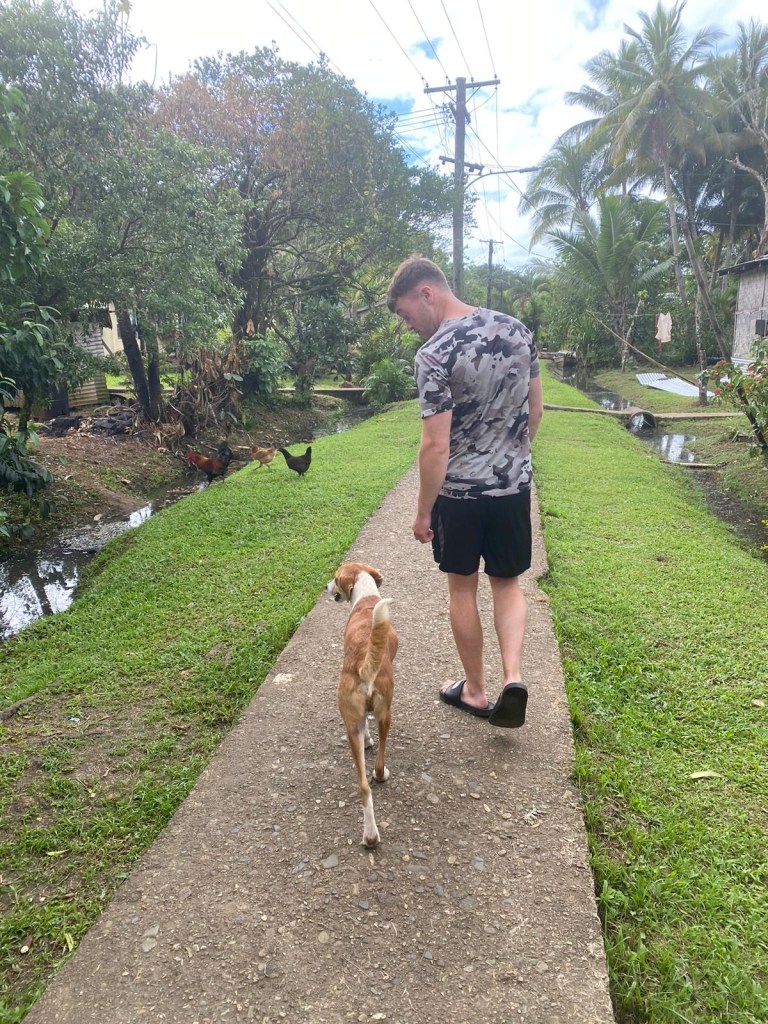
Some households have pets, but they are never allowed inside. Dogs are common in villages, yet they are not as domesticated as they are in England. One of the local strays, skinny and bald in some places (though still the best-groomed pooch in the village) must have picked up my Labrador’s scent because he kept jumping up and latching onto me all the way home.
Seeing that young girl already with a ring on her finger surprised me. In Fiji, the focus is on who, and not what, you have. I can’t imagine how scary it is for these kids leaving their villages – let alone their islands – and moving to a new one. Kissing your old life goodbye, your compass pointing to the unknown. It’s weird to think that so many of the Youth I knew in N-City have moved on. A selfish piece of me doesn’t like the thought of going back there and finding my friends have gone, but that’s life, isn’t it, folks?
Back in the vale, Na was getting busy with a chopping board. She had a bucket of chicken drumsticks, into which she deposited freshly diced garlic and onion, topped off with curry powder and some other vibrant, granulated ingredients. It helped me understand how countries known for curries make them so flavoursome. Fiji made me minutely sceptical of cookbooks proclaiming, “half a teaspoon of cumin”, “a sprinkling of paprika”.
A Fijian cookbook would say: “First, take all your measuring spoons, and use them to wipe your arse.Next, rip the spice cupboard off the wall and empty the fucker onto whatever you’re cooking.”
Na added plenty of the powdered spices to the drumsticks, letting it marinate whilst yet more garlic and onion, plus some pepper, cooked in a pan on the stove.
I offered my services and was handed another mixing bowl, plus yeast and baking bits. I tipped each ingredient in to her liking, and mixed it with my hands.“For roti,” she said, showing me how to roll and press the dough to rid it of bubbles. Dinnertime couldn’t come soon enough.
As morning rolled into afternoon, volunteers assembled at the village hall. Being guests in the village, we were to wear sulus whenever outside the house, save for during work or sport.
We met with the leaders and a group of young Fijian ladies known as the “Key Youth,” who would help us on the build and facilitate culture classes for us. All were younger than me, yet carried themselves with an air of confidence and maturity foreign to us westerners. Some already had babies of their own. Others had been parents to their siblings for as long as they could remember. Village life forces one to grow up fast.
The Key Youth took to the build site where we were to construct the medical dispensary. The site was a patch of dirt, choked by roots and brambles, and buried under dry leaves. From the build site, we paraded to the school, which catered for infants all the way up to age eighteen. The school was atop a hill, at the foot of which was the sports field, a patch of lush grass, not much smaller than a professional football pitch, with a rugby goalpost at one end. The tour concluded there. We dipped back into our homes for lunch, and then it was time to work.
Arriving at the build site, we were introduced to a Fijian man by the name of Knox. He was to be our Build Manager, and would lead the project from beginning to end.
Due to a funeral in N-City, we’d arrived two days later than planned, and needed to make up for lost time. I remember this spark lighting up inside me as hardhats, gloves and hi-vis vests were distributed.
Our first job was to clear away the undergrowth. Grinning inside, I chucked myself in amongst it like a pig in you-know-what. The rest of the team soon joined. Brits, Yanks, Sheilas, and the Fijians, grafting together to create something that could really do some good if we pulled it off. Tugging at a stubborn root, I heard one of the girls say:
“We should give out a biggest grafter award at the end.”
As if I needed any more motivation.
Tools on the job differed from what I was accustomed to. In place of strimmers, leaf blowers or bush cutters, the Fijians supplied brute-strength and machetes. A couple of hours later we had a rectangle of soil ready to build upon.
With the site clear of dead plants, we got cracking on the foundations. Knox got us to hold four tape measures the length of the walls, plus another couple hundred mm, in a rectangle to give an idea of the dispensary’s boundaries. In each corner, we knocked a wooden stake in the ground, then fixed four long timber pieces between the corner stakes in a rectangle. Kids came down to watch, but having them so close to hammers, nails and sharp bits of wood wasn’t ideal, so a couple of volunteers took them to a nearby garden for ball games.Really, twenty-something volunteers was too many for that site. If a spare hammer was going, I’d snatch it up and bash in a nail or two before someone else wanted a turn. The Fijians, many of them brought up as farmers labouring hard on the land, were a dream to work with. Skilled with the tools, always willing to offer advice, and never neglecting to let us try things. Admittedly, we felt we got in their way a lot, though their patience never once dwindled. Forming the basic frame was the day’s milestone, so most workers took to the sports field once we reached it. I noticed J and a couple of others were still working, hammering nails at equidistant intervals along the timbers. Stringlines would be pulled between these nails, and the points where they crossed would mark the positions for our foundations. I hung back to lend a hand. Key Youth members got a little nervous at me looming over to inspect their measurements, but being Fijian, they only laughed it off.
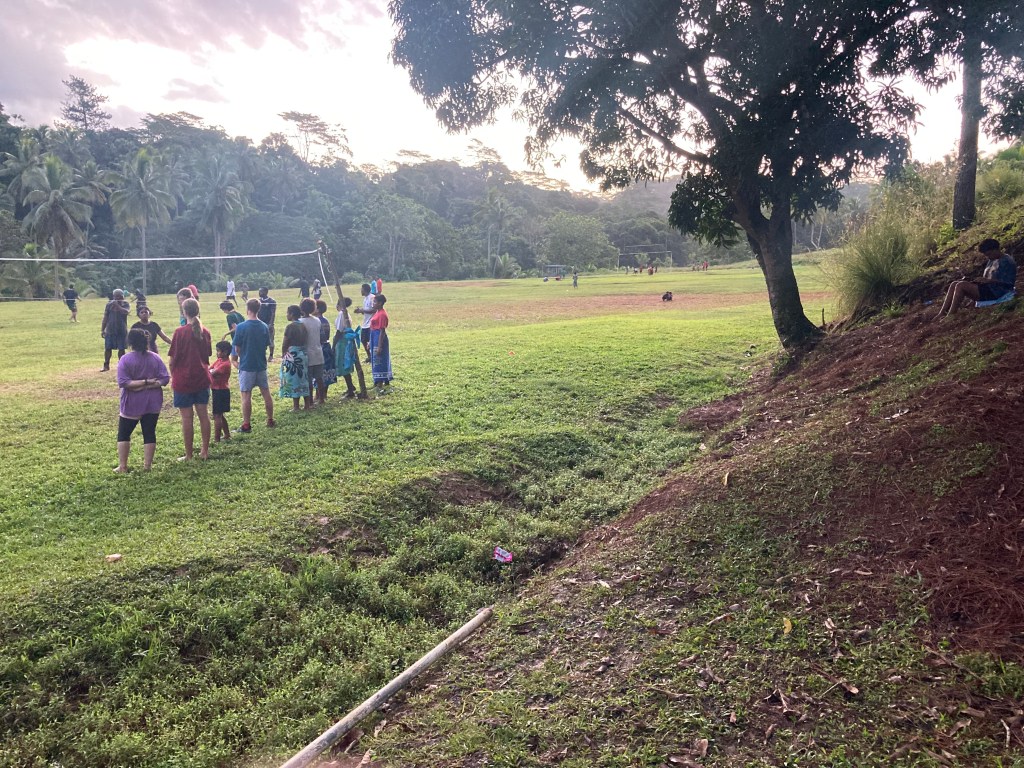
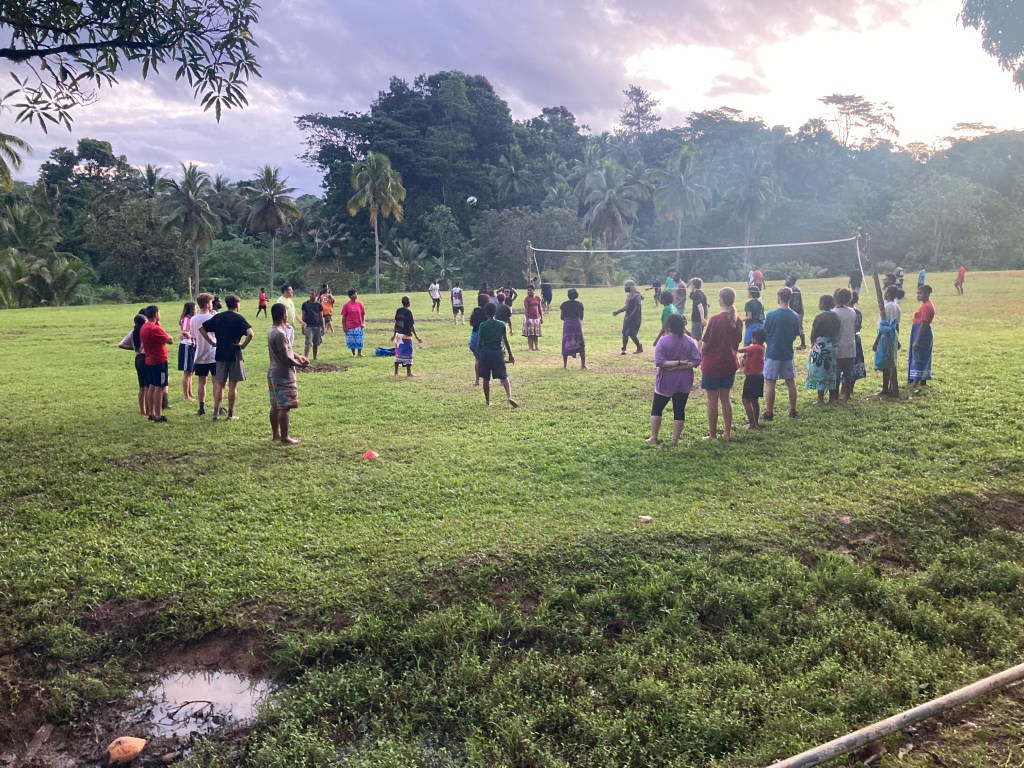
The sports field had three activities. Most Fijian men, plus some volunteers, played rugby. Two branches were impaled in the ground and a net pulled between them for volleyball. In another space, kids played mini versions of the aforementioned games. A handful of us sat on the hillside watching the games unfold. Volleyball appeared the best organised, with one person leaning against one of the posts to keep the net taught, and two others acting as umpires. The little-uns overcame their shyness and sat with us. The young girls especially were fascinated by our straight hair, constantly braiding and re-braiding the female volunteers’ barnets.
After sports, we detoured back to the dirt road. I found myself chatting to a group of schoolboys. They asked questions and laughed at my answers. One would joke about another in Fijian and receive a cuff around the ear for it. They were good kids. Everything was fun to them. Everything was a game.
Na was sat on the floor with the roti dough, breaking pieces off and rolling them flat.Upon the dining table were two bowls shrouded in tea towels. Na let me roll out the roti whilst she placed already flat ones in a frying pan. They didn’t need long to cook. I observed her technique, pinching the edge of the dough, swiping it out the pan and flipping it to fry on the other side. When I tried, my fingertips were quickly seared and went a vicious red. Na must have been so used to it that it didn’t affect her.
“Eat! Eat!” Na said. “You work hard today.”
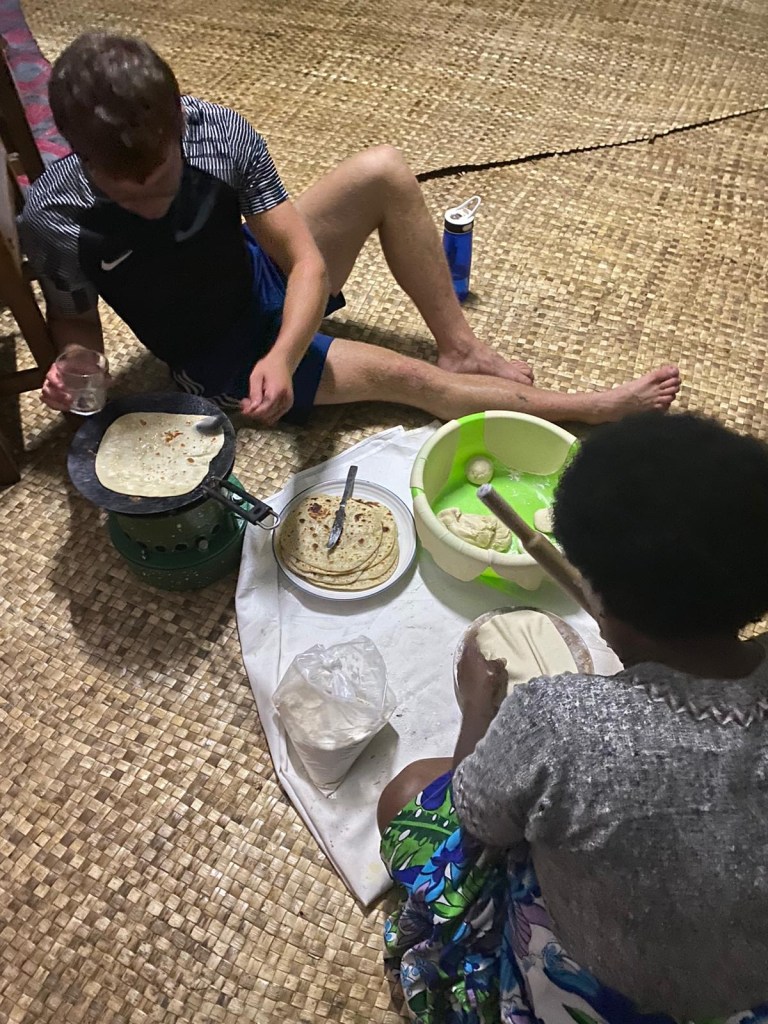
I sat with Teri and pulled away the tea towels to reveal the chicken we made earlier, plus a sizeable mound of white rice. At home in Leicester, me and my family are curry fanatics, so chicken curry, rice and roti were a symphony on my tastebuds. We cleared our plates sharpish, but in Fiji, an empty plate means plenty of space to load up again. And I, for one, am far too culturally sensitive to disregard local customs.
Bellies full, we changed into our Bula shirts and pocket sulus. Friday night meant Hop Hop at the hall, so getting dripped out was a must.
Our sister escorted us to the hall. Along the way, we crept through somebody’s garden. Sis whispered in Teri’s ear, and the next minute, he was sticking his head through somebody’s window, shouting, “Laga sere!”
Laga sere (lang-a-seh-ray) means ‘sing a song,’ and was one of the many inside jokes that everybody in N-City knew about. Lord knows where it came from, but from that fateful moment, Teri could barely step outside of the house without someone yelling the phrase at him. He’s Teri to me, but to the good people of N-City, he was, is, and always will be, Laga sere.
The party was already in full swing when we stepped in the darnce. As we later found, the village had their favourites, so the same Ayra Starr tunes and the same 50 Cent jams were on constant repeat. Paradize Rootz had just released ‘Au Taroga Lo’ (solid anthem) so that blared through the speakers at least once per Hop Hop, as well as various versions of ‘Empire State of Mind’ and T.I.’s song about being a sugar daddy.
Village children hung off the shoulders of volunteers, who were learning Fijian card games from the Youth. A few were sat in a circle playing Mafia, narrated by leader J. Not wanting to look out of place, I tagged along with Teri until the inevitable shoulder-tap came. The nays dragged up our entire circle. After a couple of dances, the awkwardness kind of goes away. Kill a few seconds by taking a Nay’s hand and spinning her one way, then back the other. And if the song ends up being over three minutes, you can always employ a ‘Vinaka’ and bow out.
Another inevitable was the kava bowl making its rounds.Some volunteers necked every bilo they could get their paws on, whilst others abstained, claiming they were groggy from the previous night. I had a couple of bowls, but didn’t stay too long. I wanted to be up and at ’em in the morning.
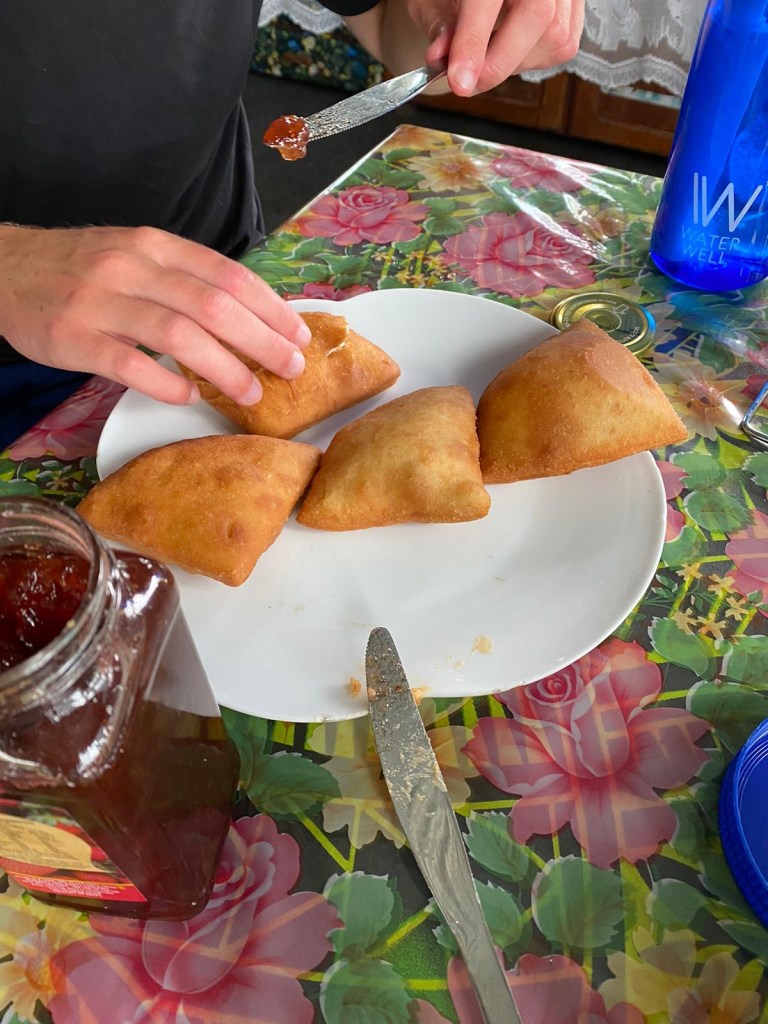
Na was again equipped with her trusty mixing bowl when I got out of bed Saturday morn.
“Roti?” I asked, peering at the dough inside.
“No,” she said, “babakau.” (mbam-ba-cow)
“Can I help you cook?”
“Go. Have bath. And after, we cook together.”
The cold water shocked most the drowsiness out of my system. Nearly falling to my death again on the slippery floorboards got rid of the rest. The first pieces were frying when I re-entered the vale. Otherwise referred to as a ‘Fijian doughnut,’ Babakau is a pastry with a crispy, light-brown outer layer, and a soft, white, fluffy inside.
Depending on your chosen filling, they can be sweet or savoury. Teri broke out his supply of jam and peanut butter, and I half-emptied each jar onto my donuts.
Saturday’s weather was fair, not too hot or humid. Perfect for a day of graft. No time was wasted with the vertical construction. Foundations would consist of thick, round wooden stakes with a piece of metal rebar driven through, in four rows of four. To accomplish this, we split into teams. One team would dig holes where the yellow stringlines crisscrossed on the base frame, whilst another cut the stakes to length. The third and fourth teams cut the rebar to short lengths, and drilled holes in the stakes for the rebar to be inserted. Team five was assigned to assembling and painting the timbers that would make the wall frames. Initially, I was on the rebar-cutting team, but we had only a couple of hand saws available, so I often found myself gripping a shovel with the hole-digging committee. By midday, the holes were dug, and the stakes ready to drop in. A wheelbarrow took centre-stage, where a duo of farmers mixed wai (water), aggregate, and cement to make concrete. Before pouring, a local priest was invited down to bless the foundations. He shovelled the first load into an empty pit. Then the elders had their turn, and so did we. Every volunteer chucked in a spadeful, and then, in teams, we filled the rest of the holes, and dropped in the wooden stakes.
Sixteen stakes later, we were bounding to the sports field with broad smiles plastered across our faces. I put in an absolutely shocking performance on the volleyball court, just assailing the ball whenever it neared.
Rourou and rice were on the table when we touched down at the vale. Rourou (roh-roh) is a curry made from the leaves of the tarou plant, very common around Fiji. The most important step when cooking is to clip the tips of the leaves. They cause severe irritation, so best to get rid if you don’t want an itchy throat. Rourou’s flavour isn’t a million miles from that of spinach, and is often paired with daal (lentil curry). Both are meals that can literally come from a Fijian’s back garden, and I reckon I had one or the other at least once per day.
No Hop Hop on Saturdays, but it was still the weekend, so we gathered on someone’s outdoor decking for a massive grog (kava) sesh. A hundred people or more, spread over the porch, passing bilos, sharing stories, learning each other’s way of life over a game of Uno, or another game the Fijians called “Last Card.”
Eventually, the speakers came out and the Nays chose their dance partners, but evenings always started with a Fijian I called “Beast” (he was almost as bolo as my Tongan neighbour from the plane), playing his guitar. This absolute unit was assisting the build during his military leave, and most nights would host a motive on his porch. He’d strum a tune whilst his friends, all hench rugby players, sang the most delicate notes that warmed the heart and teared the eyes.
Sundays were always rest days. Mornings were for church, and our family were Jehovah’s Witnesses.Me and Teri got dressed in our Bula shirts and pocket sulus, plus some jewellery from Na to complete our fits, then stepped out into a warm morning. The days hurried to get hot and sweaty even in winter and, in a thick, black pocket sulu, it only took me trekking to the bus stop to garner perspiration.
We took a bus to the next town, and then a taxi to church. Na introduced us to friends and distant family. Much of the service was in Fijian, but the bits in English, regarding intention, temptation, and so on, resonated with me. We sang hymns about ‘Jiova’ (Jehovah), Teri and I reading the lyrics projected on the back wall. Teri, whose ability to sleep anywhere was as masterful as his conversational energy, conked during a reading.
And he talks in his sleep.
I nudged him awake so the entire room didn’t hear him mumbling about Jiova knows what.
We taxi’d back to town, where Na popped into the supermarket. Out she came carrying a huge bucket of ice-cream in either hand. One vanilla-flavoured, the other, latte. Great taste, Na.
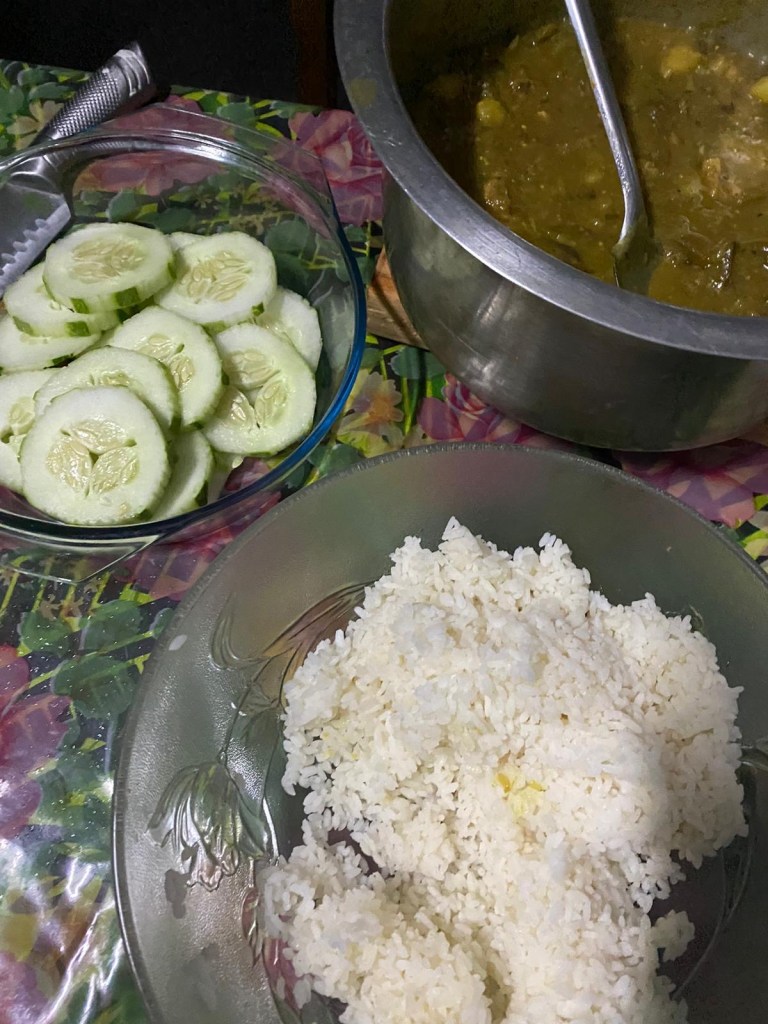
Sunday dinner was fried rice, curry, and fresh veg for lunch. Na informed us of a leaving do for a villager who was to be deployed for military service in the morning. Us boys left her to rest and wandered the village, following angelic voices singing sweet hymns until we came across a porch stacked with people. As we approached, one of the Fijians called:
“Tomasi, sit here.”
Unsure of how long the party would last, and wanting a quiet corner where I could slip out unnoticed without having to traverse a tangle of legs, I pretended not to hear. Instead, I joined some teenage boys playing cards on the grass. We sat in two pairs, making a + shape, the person facing me being my partner.What a great time to forget the name and rules of the game, but essentially we worked together to get rid of our cards. I was paired with this really cool Youth who looked like he could be related to both Floyd Mayweather and 50 Cent (Let’s call him Floyd Cent for short).
We each lay down a few cards, and suddenly Floyd Cent played his last.
“We won,” he said.“Oh!” I said, stunned by how fast it ended.
I went to shake his hand, and he held out his index and middle fingers. Confused, I gave him my own, and snap! He used my fingers to click his own.
“Whoa!” I said. “Do that again.”
He demonstrated once more.
“This is a Fijian handshake,” he explained.
The other Fijian boys turned their heads to me, nodding.
“That’s mad,” I said.
I’d never fanboyed over a handshake before, but couldn’t leave without finger-snapping with the rest of the lads sat there. From that point onwards, I noticed it much more between Fijians, and not just in N-City. Offer your first two fingers to any lad between twelve and forty in a village; I bet you get the finger snap. And, if you see Tomasi Hooke on the Skreetz and want to show you’re a loyal reader, offer them to me too.
I departed the leaving do. Fried rice and chicken for dinner. I can almost still taste Na’s fried rice. Flavoursome and soft, though never the wrong side of greasy.
Our family sat in the living room listening to Na weaving yarns in her cosy way, about how she met her late husband. A man was shouting down the road.
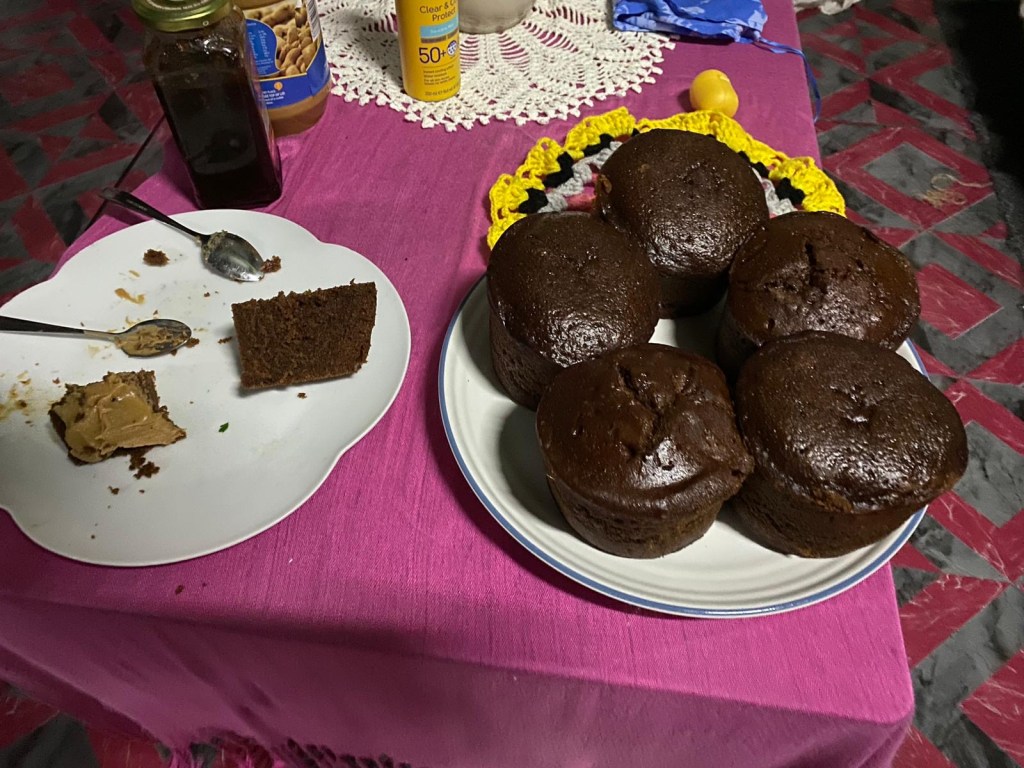
My sister was on her feet in an instant, fishing coins out of her purse whilst Na retrieved the ice cream tubs she’d bought earlier. The man’s calls were getting closer.Sis opened the door and spoke in Fijian to him. He came inside and quickly greeted us, before opening his bag and placing a number of jumbo chocolate muffins on our table. He accepted our sister’s coins and left. We were soon tucking into bowls of pudding and ice cream. Something about them being homemade by a geezer from a nearby settlement made the muffins all the sweeter.
Sleep didn’t take so long to visit me, now that I was accustomed to my mattress and my mozzy net occasionally brushing my arms and head. Eagerness contended to keep me awake, though. After a whole day’s break from work, I was suffering withdrawals. Get me back in the mud, said the man in my head who never removes his hardhat. Though that wasn’t all I was eager for. Pages in my little red notebook were starting to be occupied by Fijian phrases. I’d learned a new handshake. In the mornings, people said, “Yadra, Tomu,” (Morning, Tom). Enhancing sociability remained a goalpost for me – and still is to this day – yet, I realised I needn’t decide my value based on how much life I brought to the party. I didn’t have to be Captain Funtimes. What if I could be Captain Construction, or Captain Culture instead? For the rest of my time in N-City, I never left the vale without my little red book.

